Monday, July 5, 2021

Back In The Day, Part 45 - A 1982 Demonstration Launch

 I found yet another photo print in my archives of the old days of ROMAR.


This was taken on October 23rd, 1982 at the United States Air Force Academy.

The club participated in a model hobby demo event sponsored by the Academy and the International Plastic Modeling Society.

We were given a 45 minute demonstration window, where we managed to launch around 20 rockets.

This photo shows a rack of models ready to go. The gentleman in the red shirt kneeling to prep a model is Dr. Warren Layfield, of ROMAR. I'm not sure of the identification of the other two rocketeers in the scene. 

Other featured demos were conducted by an RC airplane club and an RC car group. The local plastic model club also had a large display booth.

Another highlight of the afternoon was a demonstration jump by a precision parachute/skydiving team.

The event was well publicized and attended by significant crowds of onlookers.


Friday, July 2, 2021

Launch Date: June 29th, 2021 - BARs at Dove Valley

 Excellent weather prevailed as a small group of Colorado rocketeers converged on Dove Valley park in Centennial for another of our vaunted launch sessions.  Jim Gazur and Roy Houchin joined me at around ten a.m. to find we had the large, well-manicured grass field to ourselves.  A light south-west breeze and temperature in the low 70s was the order of the day.

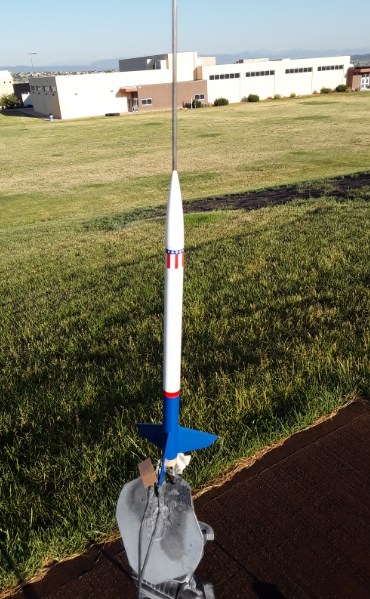
I started things off with a launch of the EAC Viper clone on A10 power.  The flight was good, but suffered yet another 'parawad', resulting in one fin breaking loose on the hard landing.


Roy soon had his first model of the day on the pad - a Moondog upscale three-stager flying on a C6-0, B6-0, A8-5 motor combination.  The model turned in a great performance, returning on a large streamer. First odd recovery of the day - the nose section stuck in the turf with the booster section beside it - a pseudo lawn dart! All parts were returned undamaged.


Today, I brought out my Orbital Transport for its maiden flight.  The bird flew very straight on a B6-4 motor.  The orbiter detached at ejection for a well-trimmed glide, while the booster came down safely on its 12" parachute. All was recovered intact. A textbook OT flight!


Around this time, Roy brought out an interesting model:


This is a Quest Planet Probe - scaled up and powered by an E16 -0 motor! The bird roared off the pad for an impressive straight-up boost and successful recovery!

My third flight of the day went to the newly-built Cherokee-E.  Not wanting to fly this bird on E power in this relatively small field, I chose to go with a D12-5 instead. Good call...


The model boosted much higher than expected, popped its 14" parachute, and began a very slow descent. With the presence of some slight wind and thermal activity aloft, I knew this one was going to be a chase. 


A quarter mile trek and a journey through waist-high weeds later, I found the Cherokee.

Unusual recovery case #2:

The model had landed on a stream! Not in- but on.  The waterway was about 2- 1/2 feet wide and flowing about a foot deep. The Cherokee's shock cord spanned the stream with the parachute and nose on one bank and the booster rocket on the other.  One fin was in the water. If the parachute had drifted another six inches, the rocket would have been submerged and likely ruined.

Phew! That was way too close.

I returned back to the launch area in time to see this model launched by Roy:


This is a Modified (i.e. "Frankenstein") Estes Flip Flier.  This one boosted on a C6-3 motor, weather-cocked, arced over, and pranged on the grass berm just south of the launch area.  Roy went on recovery and came back - beaming - holding the intact model.  No damage whatsoever!  Unusual recovery case #3!

So, what has Jim Gazur been doing this whole time?

Here's a hint....


This Estes 1/45 scale Little Joe II is equipped with a 7 motor cluster.  

Yep - 7.  A core C11-3 surrounded by six A10-0T motors populating the scale nozzles. To compensate for the additional weight in the tail, Jim had installed a tungsten nose weight.  The cluster was ignited using vintage Quest Q2G2s.


With all motors burning, the model lifted off very quickly (and majestically!). Flying straight up, the Little Joe exhibited a visible 'kick in the pants' when the six A10s burned out and exited.  


The model continued to altitude where the parachute blossomed out and brought it safely down to Terra Firma.

This was by far the most beautiful flight of the day. Kudos to Mr. Gazur for successfully pulling this one off!

Next up, I prepped my little custom boost/glider, the Mini-Maggot 3, for flight on a 1/2A motor.  I figured it would be fine to fly this small, low-powered bird on this big field.

Wrong!


I failed to remember the breeze and thermals that caused the Cherokee-E to sail away just a half hour earlier.  I also failed to recall my habit of losing gliders to Dove Valley...

Nevertheless, the MM3 flew, boosting straight up and separating perfectly.  The glider immediately settled into its signature tight-turned pattern...and caught a thermal!


Another chase was on as the bird headed north.

After reaching the top of the grass berm at the north end of the field, I spotted the downed glider - smack-dab in the middle of a six lane thoroughfare!

Unusual recovery case #4...

The glider had landed right on one of the lane lines, and to my horror I had to watch helplessly as half a dozen automobiles bore down on it.

The vehicles raced by on either side, just inches from the little glider. For some odd reason I was reminded of the old 'Frogger' video game.  

After the cars had passed, I had time to step out into the road, photograph the glider, and facilitate its rescue.  


I returned to the launch area in time to watch Roy's final flight of the day, an Estes Skywinder. Flying on C6-3 power, the model turned in a great flight.

My last flight of the day went to the Mark II Rock-A-Chute clone, again launched from a 5/16 wood dowel launcher.  The model flew nicely on A10 power.  I had decided to stick with a bird that wouldn't go too far this time.  The Mark II 'para-wadded', landing in the soft sand of a nearby volleyball court with no damage.


Jim Gazur launched the last rocket of the session, his Avionics Test Bed model, flying on a Quest Q-jet D20-4W.  


Topping out at a little over 200 feet, the model's dual deploy system worked perfectly. Jim wanted a low-altitude flight so he could get a better visual of the  recovery deployment system. The rocket also carried an Estes Astrocam video unit to get an on-board look at the process.


Unusual recovery case #5:

Jim's model wafted down on its parachute only to drape itself over one of the nearby volleyball nets! It took him several minutes to extract the bird from the clutches of the obstacle.

With that done, we packed up the gear and exited the field, vowing to meet here again in the near future. 


Friday, June 25, 2021

Launch Date: June 25th, 2021

 Yet another morning of perfect flying weather prevailed in Castle Rock, Colorado.  The temperature stood at 58 degrees and average wind speed at 2.5 mph.  Plenty of clear blue sky and sunshine as well.  The only possible worry was the presence of operating sprinklers downrange on the launch field. I made sure to angle the launch rod a couple degrees in the other direction to minimize the chances of getting a model or two soaked.

Today, I went with a couple of simple birds that reside in the collection, but haven't seen a flight within the last couple of years.

The first model off the pad was the Bandit-3 from the Estes 3-pack. This model was built back in 2018 as a group project with my two oldest grand-kiddoes.  They have long since lost interest in model rocketry, but I'm still plugging along!


The Bandit flew nicely on a 1/2A3-4T motor, reaching a good altitude, ejecting its streamer, and landing nearby.  Nice thing about these beginners birds - they are actually well-engineered and usually perform very well. They are a great example of the ''Elegant Simplicity" concept in design!

Today, I made sure I photographed the models with the stone-topped butte in the background that gives the town of Castle Rock its name.

Next up was another simple bird - the Estes Viking.  After having flown this once before and having a fiber fin get mangled, I replaced all fins with basswood versions.  Hopefully I can get a lot of flights logged on this model


Today, it performed very well on A8-3 power and was recovered undamaged.

Thus ended another great flight session!


Thursday, June 24, 2021

Other Stuff...

 For the past couple of weeks, the BlastFromThePast blog has been focused on the numerous launch sessions being conducted recently.

Today is different. Today is not the same.

This morning it is raining outside - the result of a cold front that moved into the Colorado front range overnight.  

So, no rocket launches this morning.  But I'm not complaining - this is much needed moisture that the lawn and gardens are loving about now.

So, instead, today's post is all about other goings-on in the BFTP shop.

Most of my rocketry time has been spent in prepping models for flight, and putting together the blog posts about their subsequent flights.

Little building has taken place lately, but here is the rundown:

I finally got the fin repaired on the Skeeter Eeter.  The gluing and gap filling is completed and I am only waiting on getting outside for primer and paint application.  Oops...just noticed that there is a ding on the leading edge of another fin....

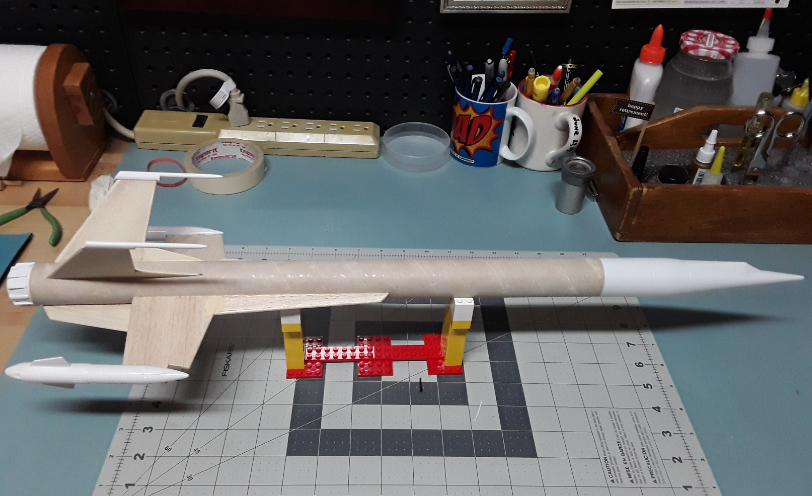
Work is in progress on an Estes Interceptor.  All the fins are glued on and ready for CWF.  The fin pods and antennae are just dry fitted right now.  These parts will be finished and painted separately prior to attaching them to the model.  Even 'nekkid', this is still a really cool model rocket design.

Work is still in progress on the Protostar.  I'm at the fine detailing stage, i.e. modeling all the little Victorian-style 'steam-punkery' embellishments.  No pictures yet on this one.  I'm waiting to get the build finished, after which I will be bombarding this blog with the remainder of the long- running build 'thread'.

On another note, Father's Day was good for me. My kiddoes pitched in and bought me this interesting device:

This garden wagon is my new transport tote for getting rockets and launch gear between the parking lot and launch area at the regional and local parks in which I fly.  This was inspired by friend and fellow rocketeer Jim Gazur, who began using such a device a couple of years ago.

My wife attended one of our launches back in early 2020 and saw Jim using his transport vehicle, and noticed how much I was struggling with juggling and carrying my range boxes, model tote, and launchers onto the field, sometimes having to make two trips.  She floated the idea for this wagon to my daughters, and here it is!  I'm looking forward to using it.

Lastly, I looked through my rocket motor inventory and noticed how alarmingly depleted it had become.  So I sat down the other night and put in an order to AC Supply.  I was sorely tempted to pick up a couple of the newest Estes kit offerings, but I refrained.  I have over a dozen kits already in my build box, and at the rate I build rockets, I'm good for at least a couple of years with what I already have.

I shouldn't say that I totally refrained:  Part of the order was for some body tubes and nose cone assortment packs.  I've got a lot of custom builds, glider models, payload bays, booster stages, and old fleet clones on the build agenda that will require more parts than what I have in stock.

So, anyway, there is the run-down of what's happening in my little corner of the model rocketry world. 

I'm looking at the weather forecast for tomorrow morning.  Looks like I'd better get down to the shop and start preppin'. 

Cheers!

Wednesday, June 23, 2021

Launch Date: June 23rd, 2021

 Yet another morning of absolutely perfect flying weather prevailed as I turned my steps to Douglas County High School for a short launch session.

This time, I only had one model prepped for the outing:  the Astron Alpha.  For this flight the bird was equipped with my specially built payload section designed to carry both an Estes altimeter and the Flight Sketch Mini, for comparison purposes.

The model flew beautifully on a B6-4 motor, successfully deployed its parachute, and landed gently a mere 30 feet from the launch pad. 

Here are some images of the flight data provided by the FlightSketch:


The altitude recorded by the Estes altimeter read 487 feet, only a 5.9 foot difference from the Mini's reading.  A good sign...

More of these types of flights will take place in the future to ascertain consistency.

I am really enjoying these early morning summer launch sessions.  The weather is usually ideal.

It is my plan to get as many such flights in as possible before I start seeing the fire danger burn bans put in place by the local authorities.

Cheers!


Tuesday, June 22, 2021

Launch Date: June 22nd, 2021

 Today, I ventured out for yet another of my early morning rocket launch sessions at Douglas County High School.  Again I enjoyed nearly perfect flying weather featuring warm, calm , and clear conditions.

The two birds chosen for this outing hark back to the old days of model rocketry.  In fact, both designs are ones that G. Harry Stine himself had been involved with.  It's been at least two years since I've flown either one of these models, so I figured it was a good time to get some air under them.

First off the pad was my replica of the MPC Super Star.  Back in the day, it was one of the models in the company's 'Mini-Roc'" line, designed for use with the newly introduced MPC 13mm motors.

Today, the Super Star flew on an Estes 1/2A-4T motor.  It lifted off beautifully, flew straight and true to a fairly impressive altitude, deployed its streamer, and landed safely.  A picture-perfect flight.

I haven't yet dared to fly this model on an A motor - it goes plenty high enough for my poor eyes to track on a 1/2A.  I can only imagine how high this model would have gone on one of MPC's old 13mm B motors!

Next up was my scratch-built replica of the Mark II Rock-A-Chute.  Flown from the old school wood-dowel launcher and an A10-3T motor, the model turned in yet another solid flight.  Recovery was perfect on its red 12" square parachute.


I really enjoy these vintage rocket designs.  They truly are a kick to fly!


Monday, June 14, 2021

Launch Date: June 14, 2021

 Today, I once again made the short hop to Douglas County High School for another of my 7 a.m. 'shoe box' rocket launch sessions. This is my third such event over a span of four days.

This morning's weather was absolutely ideal - 75 degrees and virtually no wind.

Today, I left the EAC Viper flagship at home in favor of putting up another keychain video camera flight as well as another of my earlier models that hasn't been flown in awhile.

The carrier rocket for the camera was the Quest Big Rage.  This model seems to have become the workhorse for handling all of these video flights.

Powered by a B6-4 motor the model boosted very nicely to an estimated 300-350 foot altitude.  At ejection the parachute deployed fully and brought the model in to land about twenty feet from the launch pad. 

The second flight of the session went to the diminutive Star Seeker.  This was one of the three rockets in the long ago Estes Mini-Tri-Pac kit.  I built it a few years ago because I just like the design.

Flying on a 1/2A3-4T motor, the Seeker boosted surprisingly high.  Once again, I was elated to see its little 6 inch parachute deploy and bring it in for a safe landing, again quite close to the launch pad. I resorted to using a parachute because the model's previous flights relied on either break-apart or streamer recovery, and always ended up with one or both of the fragile fin assemblies breaking off.  This time the model landed intact.

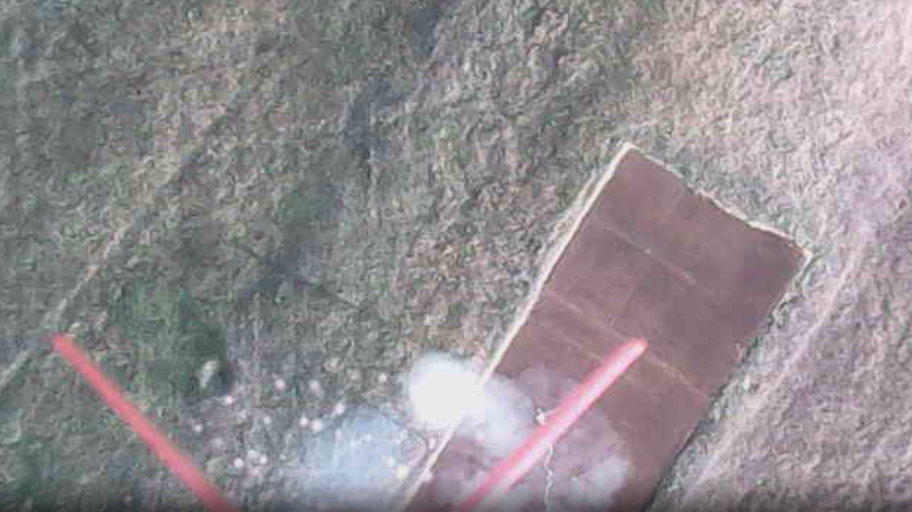
After I got home, I connected the keychain cam to the ol' PC to check out the flight video.  It recorded successfully, but the video was quite unremarkable.  Apparently, the ejection charge went off just before apogee, so the model didn't arc over and get any images of the horizon, or any interesting features surrounding the flying field.  The entire video consisted of aerial shots of the launch field grass. 

Here is one still frame showing the cement pad from which the model was launched:

I intend to improve this on future vid-cam flights by cobbling together a rigging system that will hold the camera at an angle under the parachute.  Lots to learn....