Thursday, April 8, 2021

A MAJOR Blast From The Past !


Way back in 1975-76, I was in college taking course work toward an Associates Degree in Mechanical Design Tech.

Much of this involved mechanical drafting classes.  We're talking Old School mechanical drafting classes : T-squares, triangles, compasses, French curves, circle templates, lettering guides - the whole she-bang!  I still remember the hours spent laboring over painstakingly accurate dimensioning and attention to pencil pressure so that the drawings would reproduce well on the blueprint printer machine.

In those days CAD was way off in the future.

I still have in my possession the entire set of drafting tools that I had purchased and used in those long-ago classes.

I recently dug out and dusted off this ol' box o' tools.  I started pulling each item out of the box one by one to examine it.   Then something weird happened.....

I watched in helpless horror as my hands, working independently of  any attempts to control them, started working with these old drafting tools !!

In no time, I had a complete rendering of the Skeeter Eeter 3 staring up at me from the work table!

I am actually quite rusty at this hand-drafting business, but it all seemed to be come back to me very quickly  Even though this could all be done much more efficiently on a PC, I have found this old-school way of doing things to be quite relaxing and satisfying.

So now, my new side project is to hand-draft the plans to all of my custom designed model rockets, past and present, scan them into PDF files, and post them here on the blog for anyone to use and enjoy. 

Hey, I've got time on my hands...I'm retired!

Cheers!

Tuesday, April 6, 2021

BAR Fleet No. 131 - Skeeter Eeter 3


Model Type: Sport

Designed by Ed Mitton. 

3x upscale of Estes Industries Mosquito

Motor Type: 24mm x 70mm

Recovery: Parachute or Streamer

Nose Type: Parabolic, Plastic

Fin Type: Rounded Swept, Balsa

Number of Fins: 3

Length: 11.81 in. (30cm)

Diameter:  1.64 in. (41.6mm)  BT-60

Weight empty: 1.45 oz. (41.1g)

Color scheme: Overall-Orange (Rustoleum ‘Real Orange’), Silver Trim Monokote,

Black Markings.

Completion date: April 5, 2021

 A Mosquito On Steroids !

What could be better than building and flying a Mosquito?   Building and flying a significantly larger Mosquito powered by ‘The Mighty D Engine', of course!

Back in the Old Fleet days, circa 1975-1977. I built two of these things - the first was a 24mm D-motor version, followed by an 18mm standard motor iteration.  Both of the models pre-date Estes' release of the Mega Mosquito kit.

Since part of my present-day BAR adventures involves re-building some of my Old Fleet favorites, the Skeeter Eeter has been a sure bet to hold a position high on the build list.

Purchase and kit-bash of an Estes Baby Bertha provided all the major parts required by the Skeeter Eeter, save for motor mount components, which I already possessed in my parts stash.

The build is very straight forward, this being a regular old 3FNC model rocket. No worries here.

Skeeter Eeters are a real kick to fly.  I anticipate watching this 2021 version screaming off the pad!

Monday, April 5, 2021

Back In The Day, Part 39 - HOTROC-4

 The fourth edition of the Heart Of The Rockies Regional competition meets was held in Colorado Springs over the weekend of August 20-21, 1983.  Contestant turnout was roughly the same as the previous year - about 20 contestants from Colorado, Utah, Wyoming, and Kansas.  

HOTROC- 4 was flown from the same field as the previous year, and Contest Director was ROMAR member George Fox.  

Since I was not directly involved with much of the planning or detailed operation of HOTROC-4, I don't have any contest records or results in my files to present in this post.  But here are a few photos, newspaper clips, and other bits I could find in my archives                        :

A scan of a HOTROC-4 announcement published in The Cosmic Steppingstone.  
Would you attend a model rocket contest hosted by such a motley crew as this?   

Of course you would!  Looks like loads of fun!


Scans of an original HOTROC-4 programme, opened to the pages showing the 
schedule and competition event descriptions.  (All drawings by me!)


Pre-flight checkout of  Randall Redd's D motor Boost/Glide entry. 
Left to right: Randall, Gary Price, and Mike Mitchell.


HOTROC-4 news article published in the Colorado Springs Sun.  The accompanying photograph is of Denver rocketeer Steve Sande launching his D motor super-roc model.

My D boost/glide entry takes to the skies.

Gary Price's D boost/glider caught at liftoff.


HOTROC-4 news article published by the Colorado Springs Gazette Telegraph.

Mike Mitchell of Kansas displays his super-roc entry prior to flight.


Randall Redd with two of his odd-roc models: a flying bumblebee and an oil can....thing.

Gary "Lawrence of Arabia" Price poses with an odd-roc entry.

Once again, HOTROC-4 proved to be a very relaxed, well-run, and enjoyable meet.  And, as in previous years, the contestants left the field Sunday afternoon with thoughts of next year's HOTROC-5 uppermost in mind.


Thursday, April 1, 2021

Things Are Finally Looking Up!

 Today, we finally got a good high pressure weather cell parked over the State of Colorado.  This means we are actually enjoying a week without cold temps and snow!  And the windy conditions have died down as well. The thermometer is up in the sixties.

I took the opportunity to get outdoors with the rattle cans and get a little rocket painting done.

The 'Skeeter Eeter' upscale Mosquito has been sitting in primer for months, so I managed to apply the color coat.

I had originally planned to give the model a black nose, and one black fin, but instead opted for all-orange.

The two body tubes of a Quest Nike-K build got their coat of primer today, as well. They should be ready for sanding and paint application tomorrow.

Hopefully, both builds will be finished and added to the fleet in a few more days.

The Steampunk Protostar build is also progressing steadily.  I'm not going to divulge any info on that one until the model is completely finished, after which I will inundate this blog with en masse posts!

The best news is, I am busy prepping birds for my first 2021 launch session tomorrow. I just got past the recommended two week waiting period after the second Covid vaccination, so I'm definitely good to go.

Tomorrow's weather forecast models look very good for the Colorado Front Range, and there are none of those pesky burn bans in force at the moment.

Here is a pic of some of the models scheduled to get some air time tomorrow. 

Most are newly built birds that will be on their maiden flights.  I may take along a few additional older models as well.  I will also be spending some time hand-launch glide trimming the newly built Orbital Transport...Orbiter.

Likely, there will be a new 'Launch Date' post here in a couple of days.

Stay tuned!


Wednesday, March 31, 2021

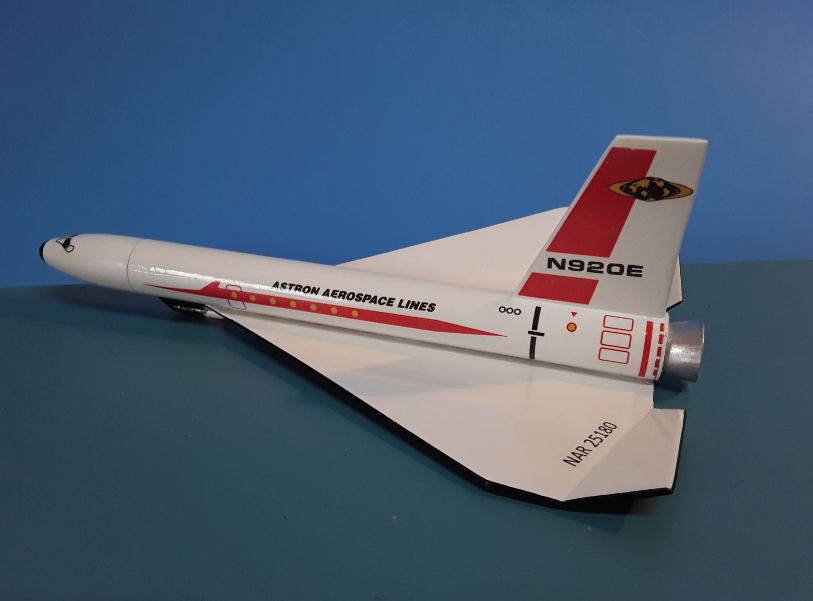
BAR Fleet No. 130 - Orbital Transport


Model Name: Orbital Transport

Model Type: Futuristic 

Scratch build version Estes Industries kit no.  K-42 / 1242.  Designed by Wayne Kellner.

Motor Type: 18mm

Booster Length:  58.8cm (23.15 in.)

Booster Diameter:  24.8mm

Booster Weight:  42.5g (1.50 oz.)

Orbiter Length:  22cm  (8.66 in.)

Orbiter Diameter: 18.7mm

Orbiter Wingspan:  13.2cm ( 5.2 in.)

Orbiter Weight:  15.0g  (.53 oz.)

Overall Vehicle weight:  57.5g (2.03 oz.)

Color scheme: white, gray, black, and silver with red, black, and yellow trim.

Completion date: March 31, 2021

A Must-Have Model In Every Fleet

The Estes Orbital Transport is one of those iconic model rockets that every rocketeer should own.  It just has 'that look' - attractive lines, proportions, and decor - that is plain irresistible.  The first time I ever laid eyes on one was in 1969 at NARAM-11.  The bird was proudly displayed at  Estes Industries' vendor booth.  I was smitten!  To a thirteen year old kid, that thing was the coolest rocket ever!

I ended up building one in 1975 during my Old Fleet days.

 It doesn't need to be said that an Orbital Transport is a requirement for inclusion in the new BlastFromThePast BAR fleet.

The JimZ website provided the instructions, patterns, and decal scans to make a clone build possible.

This OT build was actually a long time in realizing completion.  The many fins were cut out way back in early 2018 before the project was shelved while other models were built. They were done the old school way - tracing the paper patterns onto balsa sheets and engaging in LOTS of cutting with an X-Acto knife.

No laser-cut fins to be found here....

When it came time to begin painting the model, I quickly made the determination that I would not go with the usual all-white color scheme.  I just didn't want my Orbital Transport to look like every other Orbital Transport on the planet!

I arrived at a painting plan that called for the upper half of the booster fuselage to be white, with a medium gray color for the lower half.  It should be noted that the gray portion was brush-painted with hobby acrylic paint. Black trim lines separate the two colors, and these extend to the edges of all fins.  The protruding sections of the booster ram jet tubes are hand-painted silver.


To round things out, the booster nose was given a black tip to make it look a bit more Space Shuttle-esque.

For the Orbiter, I chose to paint the bottoms of the wings black.  Again, this and the black tip on the nose give it an appearance more akin to the Space Shuttle. Lastly, the Orbiter engine nozzle was painted silver.


Overall, this was a very pleasing project to work on, not to mention being the most challenging build to date in my BAR era.


Monday, March 29, 2021

Back In The Day, Part 38 - The Cosmic Steppingstone Newsletter.

 When the Rocky Mountain Association of Rocketry / Skywatchers rocket club made its debut as a section of the NAR in 1974, one of the first orders of business was to establish a news letter.

I was a senior in high school at the time, and was taking advanced English and creative writing classes. In addition, I was taking a mechanical drafting class.  Naturally, I was elected as the first editor of the club newsletter, The Cosmic SteppingStone. 

 In subsequent years, the editor was elected along with the other club officers for a one year term.  Besides myself, editorial duties were handled by club members Marc Kramer, Lester Coburn, Glade Gordon, and Brian Fox.

The masthead of the premier issuecarried a drawing of a circular space station, very crudely drawn as there was a  huge rush to get the publication worked up and printed.

By the time issue #2 came around, I had more time to sit down and draw up a much better rendition of the station.

Like most club newsletters of the time, the CSS carried the usual things such as event calendars, editorials, meet reports, general club news, cartoons, rocketry tips and techniques, and the occasional rocket plan submitted by a club member.

The club's printing process wasn't exactly the greatest, so any attempt to include photographs was a dismal failure.

These were also the days before the advent of personal computers and word processing software.  For many years the newsletter was laboriously pounded out on a mechanical typewriter, usually by a late-night, bleary-eyed, caffeine-laden editor.

At one point in the mid 1970's, printing was done on one of those old hand cranked, purple-inked mimeograph machines that one of the club members had obtained on the cheap. 


By 1978, publication process was pared down to a two or three page affair with no masthead other than the type-written newsletter name and issue date.  

No newsletters at all were published from late 1978 through all of 1981.  This three year hiatus was the period when the club was down to five members and activity was at an all-time low.

Things changed big time in 1980.

The NAR presence in the Mountain States region enjoyed a huge resurgence. The HOTROC regional contests were in full swing, and ROMAR re-chartered as a section.

The Cosmic Steppingstone was re-born in a much slicker format.  As the premier editor of the new order of things, I re-designed a new mast-head and began including full front page illustrations.

Huge improvements were made in newsletter layout, regular features and articles were graced with graphics and clip art.  For the first time, the club's printing process was adequate enough to reproduce photographs with a bit better quality.  Submitted rocket plans were also very professionally drafted. In those days, there was a lot of real paper cut and paste work done, as well as hand drawing column separation lines. It was way more work than what we can do today with modern computer publishing apps.!

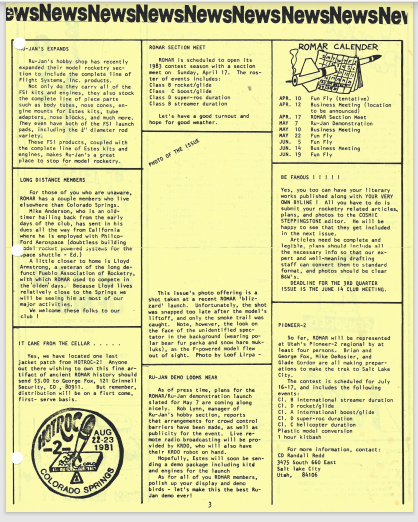
A Sample page of the CSS 'New Look'

In the last years of the Cosmic Steppinstone's publication, we enjoyed a healthy newsletter exchange with many of the well-known NAR sections around the country.

I still have all of my original copies of the newsletter, which I enjoy taking out once in awhile to spend an evening re-reading and reminiscing about the 'goodle days' of ROMAR / Skywatchers.  

Even more importantly, these old documents have proven a very valuable resource for digging up information for this blog series on the history of ROMAR!

Cheers!


Monday, March 22, 2021

Back In The Day, Part 37 - The Citadel Mall Rocketry Display

 In 1979, the Skywatchers Model Rocket Club of Colorado Springs set up our largest indoor static display ever in the city's premier shopping mall, The Citadel. 

This event was actually my brain-child.   I had worked for a couple of years on the maintenance crew at the mall, so I was well acquainted with all the folks in management.  I floated the idea to them of allowing the Skywatchers rocket club to set up a well-publicized display in the main hub of the center.  The mall management went one step better and suggested expanding the event into a mall-wide hobby show extending over an entire weekend! Of course, I didn't hesitate to volunteer to contact the various hobby clubs around town and get the whole event organized.  The mall manager would schedule the date and take care of advertising and press releases in the local newspapers.

There was a lot of work to be done in the intervening weeks.  The club set to work designing and building the display boards and table layout. I began calling the various hobby clubs around town.

When all was said and done, I ended up with several organizations who committed to participating in the event:  an R/C model airplane club, an R/C model boat club, an R/C car group, a miniature military replica club, the local coin collectors' club, and even a couple of local artists.  Sadly, the nearby model railroaders declined to join us, citing the difficulty of setting up a working rail layout in time for the show.

Here is a hand-drawn flier I put together, made copies, and posted in all of the Springs hobby shops:  

Following are some pictures I took at the event:

A table showcasing some of the members' sport model rockets.

Club president Glade Gordon at the scale model display 
showing off a Saturn V to some interested visitors.

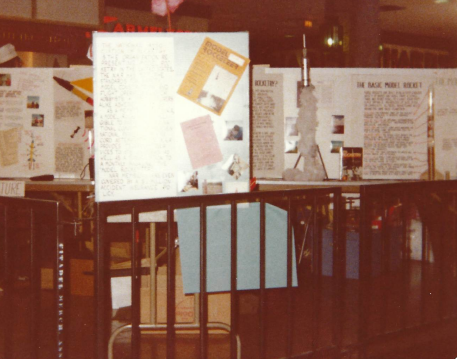
A display table with posters explaining all about model rockets, how they work, 
and an introduction to our club and the NAR.

A table showing the technical aspects of model rocketry.  Included in the display 
were a Cineroc movie camera and an Estes TransRoc transmitter.

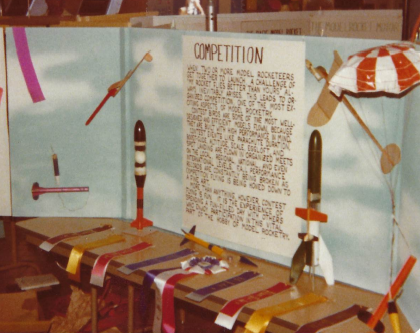
A display showcasing the various aspects of competition model rocketry.

The show turned out to be a great success, drawing considerable crowds throughout the weekend.  All club members were on deck to man the displays and hand out club promotional material. As a result, the Skywatchers club enjoyed a decent surge of interest in club membership soon after. 

Most of all, it was highly enjoyable opportunity to show off and talk about our great hobby to a lot of folks who were unfamiliar with model rocketry.