Monday, May 6, 2019

An Unexpected Model Rocket Windfall

This past Saturday, my wife and I traveled to Colorado Springs to visit some long-time friends there.
After dinner, the gentleman, whose name is Bob, disappeared down the stairs leading to the basement and emerged a few moments later carrying some model rockets, some un-built kits, and a box.
Setting the items down on the table in front of me, he declared, "These are all yours if you want them."

Bob explained that he had bought all of this stuff back in the mid 1990s with the intention of getting into model rocketry and involving his two young daughters .

As it turned out, the kids didn't develop much of an interest - a handful of rockets ended up being built, but none were ever flown. Bob ended up dropping the project himself, soon after.

The rockets and materials have been stored in his basement ever since, never seeing the light of day.  Bob explained that he would probably never use them, so he offered to give them to me, knowing that I am deeply immersed in the hobby, and would make good use of the items.

I thanked him profusely, and accepted the gift, promising I would send him launch photos of any flights of these birds.

Yesterday, I unpacked the boxes and took inventory of all my new rockets and accessories.

First, the built rockets:


Identification of the large model was unknown to me.  Bob couldn't even remember the manufacturer or kit name.  After a little research on the interweb, I learned that this model is the Quest Big Rage, an easy builder's kit utilizing a plastic Nike-Smoke nose cone and fin can, and pre-colored body tubes.

The other two rockets were much easier to identify: an Estes Viking, and a Quark.

The un-built kits in this stash consists of these:


A Quest Icarus, and an Estes Big Daddy.  The latter is perfect for me, since it is a D engine rocket highly suited to the small fields from which I generally launch.  As for the Icarus (and the Big Rage above), I might just have to grab up some of the new quest D's...

Next is the 'mystery box' full of stuff...

 
The first thing I found when I opened the box was this...
 
 
So, the box is identified as the Super Shot starter set from Estes that included two rockets - the Super Shot and Twister, both E2X birds.  The models were missing from this set. 
Inside, I found a complete Porta-Pad II launcher, an Electron Beam controller, and a two piece launch rod, all of which had never been used.
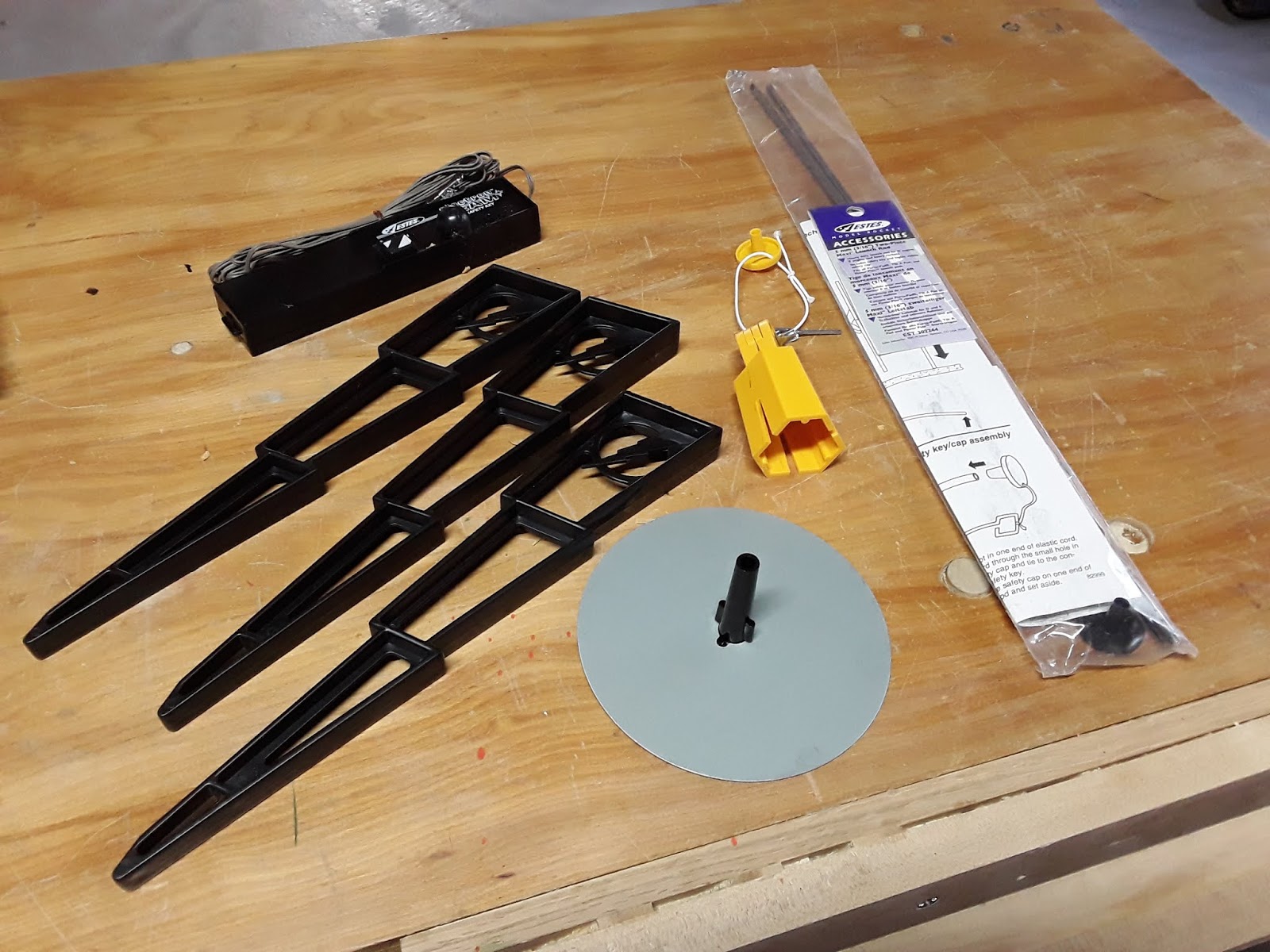
 
 
Other items in the box include instruction sheets for the Super Shot rocket, and the launch controller,
a Rocketeer's Guide booklet, a package of A8-3 engines, a small packet of recovery wadding,
a bag containing a couple of launch lugs, and the plastic tube coupler left over from the Super Shot rocket kit.
 
 
The biggest surprise of all that I found in the box were these:


A whole slew of engines!
 
All of these unopened packs date back to the mid 1990s.  Note that several of them carry the 'COBRA' labeling.  These engines were all produced around the time that Estes began using the new 'starters' and plugs.
 
Bob informed me that the engines have been stored all of these years in his cool, dry basement where there have been no temperature or humidity changes.
 
That's good enough for me!  I fully intend to use them.
 
Now, it's time to really get busy in the BlastFromThePast shop....
 
Cheers!


Friday, May 3, 2019

Back In The Day, Part 21 - ROMAR in 1974. 'Twas A Very Good Year.

ROMAR's first year as a section of the National Association of Rocketry was a very busy one.

One of the major watershed events early in the year was the occasion on which NAR pioneer Bill Roe stopped by one of the club sport launches and made us an offer we couldn't refuse.

Bill ended up donating the complete set of range equipment that had been used by the then-defunct Peak City Section....
 
The whole kit & Kaboodle...

Launch Racks, launch control panel, PA system, tracking station phones, tracking scopes, and even a tall flag pole!

ROMAR made good use of this equipment for the first couple of years.  Eventually, the launch panel and PA were replaced by smaller, more compact units, but the launch racks were used well into the 1980s for most of the club's demo launches.  One of the tracking scopes was stolen right from the launch field during lunch break at a contest meet in early 1974.

I do not know whatever became of this equipment after ROMAR ceased to exist in 1984.  Presumably it is in storage at one of the ex-senior members' home.  I hope that it may come to light someday, as the items could very well be valuable as welcome historical additions to the Museum of Flight in Seattle.

Armed with the new launch equipment, the club members spent one weekend fixing up the launch field.  A local construction company graciously graded an access road from Airport Road to the designated launch site.  The club rented a trencher and was able to lay in permanent phone lines to the tracking station locations.  We also installed some posts marking the perimeter of the launch area.

ROMAR's very first NAR contest was a Section meet held on March 24, 1974.  The events were (in the old event parlance) Mercury Dual Eggloft, Hawk (C) Boost/Glide, Peewee Payload, and Class III (C) Streamer Duration. The event roster was fairly aggressive for a new section, but the meet went very well.

On April 21st, 1974, ROMAR hosted an NAR sanctioned Open meet, attended by members from the Pueblo Association of Rocketry, led by Lloyd Armstrong, and a couple of independent NAR members that drove down from Aurora, Colorado.  The same events as the section meet described above were flown.

Aside, from other regular sport launches, 1974 was also the year when ROMAR began doing some serious demonstration launches in and around Colorado Springs. One of these events became the first in an annual series of demos spanning the entirety of Skywatchers/ROMAR's existence.  I will describe these in an upcoming post.

Unfortunately, I have no photos in my archives of those earliest days of ROMAR, save one unclear shot of the Open meet published in the Cosmic SteppingStone news letter.  The photo doesn't show much, so I won't even attempt to reproduce it here.

Next post: Skywatchers in 1975-1978.

Thursday, May 2, 2019

3rd BAR Birthday Today!

I can't believe it's already been three years into my BAR era. 
Where does the time go?

Wednesday, May 1, 2019

Back In The Day, Part 20 - The Birth of ROMAR

The January, 1974 meeting of the Skywatchers Model Rocket Club was different in that we were now an officially chartered section of the NAR - The Rocky Mountain Association of Rocketry (ROMAR), section #103.

The original charter members of ROMAR consisted of  Frank Gee, Glade and Lillian Gordon, Lester and Barb Coburn, Tim Harris, Randy Rinehart, Randy Blosser, Marc Kramer, and myself.  In 1974, a club was required to have a minimum of ten NAR members to be able to form a section. There may possibly have been a couple of other individuals in the club at the time, but I have no existing record of their names.

When it became known to the club officials that I was enrolled in Advanced English and Creative Writing courses in high school, the editorship of ROMAR's brand new news-letter, The Cosmic Steppingstone, automatically fell into my lap.  If memory serves me right, I believe it might have been Marc Kramer who proposed the name of the news-letter.

Never did I dream that forty-five-plus years later I would again be writing about model rocketry - and to an international audience, no less!

Once the organizational structure was in place, the section immediately set about with establishing a schedule for meetings and launch sessions.  In looking through back-issues of the news letter, I am astounded to find that we scheduled business meetings once every two weeks with a launch session the following weekend! 

Sheesh! 

I could never keep up with such an intense schedule these days. It's a wonder any of us found time to build rockets!

Next post:  1974 - A Great Year For Model Rocketry In Colorado Springs

Monday, April 29, 2019

Steampunk Protostar, Part 28 - A Riveting Tail

Taking a step away from the launch lug construction, the next procedure in the build is making the riveted panels for the body tube.
Each section of the tube will be done separately with eight panels of equal width applied around the model's circumference. 
This will be the most difficult section due to the need to fit the panels around the fins and the aft launch lug.
As with the fins, the riveted panels are made from Avery paper with poked-through rivet detail.
Here is the first panel measured out, marked, cut from the larger label sheet, and rivet detail applied.

 
Before affixing the panel to the model, I like to lay it along the edge of the bench and burnish the edges with an Xacto knife handle.  This helps to flatten the slightly raised edge that was formed when the panel was cut out.
 
 
Now the panel can be carefully placed into position.  Not that there is no rivet detail next to the fin root.  This area will later be covered up with an addition glue fillet layer and more detailing.
 
 
This is the panel that encompasses the aft launch lug mount.  Since I want the lug to be glued directly to the body tube later on, I must cut the paper panel to fit around the lug footprint.
 
 
Once two adjacent panels are in place, I press the seam down with the curved end of a pair of tweezers.  This evens out the edges and ensures that they are properly stuck down to the tube.
I have to be very careful not to allow the handle to wander over onto the rivet detail, as it will flatten those features out as well.
 
 
And, so it goes with the remaining panels around the circumference of the tube. 
Note that I am not overly concerned that the ends of the individual panels do not precisely line up.  These will be covered later on with some wide simulated steel banding details.
Here is the completed tail section....


Each of the panels took between half an hour to forty five minutes to lay out, cut, detail, and apply.
This is probably the most finely detailed model rocket I will ever build.  A lot of time-consuming small-scale work, but it's been fun so far.
 
Cheers.


Wednesday, April 24, 2019

Steampunk Protostar, Part 27 - Building The Launch Lug Standoffs

Now that the launch lugs themselves are completed, it's time to fashion the fancy standoff mounts.

To start off, two scrap pieces of 1/8 thick balsa are laminated together.


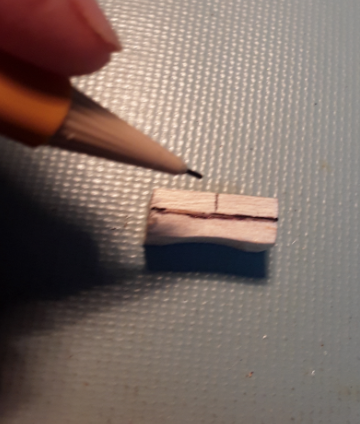
Once dry, four standoff blanks are carefully cut from the stock.  The lengths of the pieces are 10mm to match the mounting ring on the lugs.  The standoff widths are cut equal to the width of the riveted panels that will be applied to the main airframe, 1/8 the circumference of the body tube.


Center lines are drawn across the front and rear edges of each of the standoffs.  These are meant to be a reference for shape sanding.

Because the standoffs will conform to the curvature of the body tube, a sheet of medium grit sandpaper is wrapped around the Protostar nose cone base to make a jig for shaping the balsa wood parts.
Keeping the pieces perfectly aligned, they are carefully sanded until the apex of the curve reaches the reference line.

 
The sanded lugs are checked for fit on the body tube and marks are made for launch lug placement.


Using a sanding block, the tops of the standoffs receive a curved surface as well.


Here are the four finished standoffs.


And, the completed glued-up launch lug assemblies.  I had to be very careful with this step, in that the lugs have to be precisely aligned.


Whew...I'm feeling a bit standoff-ish today!

Perhaps a can of Mountain Dew might help....


Monday, April 22, 2019

Back In The Day, Part 19 - ...And Then There Was 'Skywatchers'....

The genesis of the Skywatchers / ROMAR model rocket club in Colorado Springs is largely shrouded in mystery - at least as far as yours truly is concerned.  The organization was already in existence before I arrived and stuck my long nose into the action.  I'm sure that any of the folks who were original members might know when the club first formed, but I haven't been in contact with them for many, many years.  Skywatchers may well have originated as early as 1972.

Anyway, at the invitation of my high school chum, Marc Kramer, I joined Skywatchers in the summer of 1973.  I was a junior in high school at the time, and had a few small models built and a little bit of flying experience under my belt, but I was still quite a neophyte to the hobby.

The original club roster consisted of maybe a dozen members, and held monthly meetings in the back room of Custom Hobbies at the intersection of Platte Avenue and Circle Drive in Colorado Springs.

The club's flying range was a large field on the east side of town off of Airport Road.  (Incidentally, Airport Road did not go to the airport....). The field was large enough to accommodate F-engine flights.  Even though the space was earmarked for future development, Skywatchers gained permission to us it in the interim. 

It's interesting to note that the second home my wife and I bought in the late 1990s was located on the downrange end of that very same field.

At the December, 1973 club meeting, it was announced that the Skywatchers Rocket Club had submitted an application to the National Association of Rocketry for becoming a chartered section.

Next Post:  The birth of ROMAR