Thursday, August 23, 2018

FlatCat Boost/Glider Build, Part 12 - FlatCat For Lunch...Yummmm!

Right across the street from my workplace in Highlands Ranch, Colorado, is a nice, large public park with a decent expanse of grassy area.  Appropriately, for a model rocketeer, the place is named 'Redstone Park'. 

Unfortunately, park regulations prohibit the flying of model rockets there, but I can still use it as a place to hand launch and trim boost/gliders.

So, I brought the FlatCat B/G to work to keep here in order to take advantage of a lunch hour this week during which there would be minimal wind activity.  It only takes two minutes to pop over to the park and start flinging gliders around!

Last Monday, Aug. 20th, I made an attempt to trim the FlatCat glider at the park during my lunch break. 

I managed to get in a half dozen test throws before some session-ending winds picked up due to a thunderstorm that was building in the foothills to the west.  Blasted storm!

By the time I made the final toss, I had the FlatCat trim balanced to glide fairly well.

On the last test flight, I heaved it into the wind.  The model climbed to an estimated 40 foot altitude, aided by the wind, turned, and settled into a nice glide that described a wide turn to the right.  This hand-launched flight went for well over 25 seconds, and I ended up chasing it over half the length of the field!

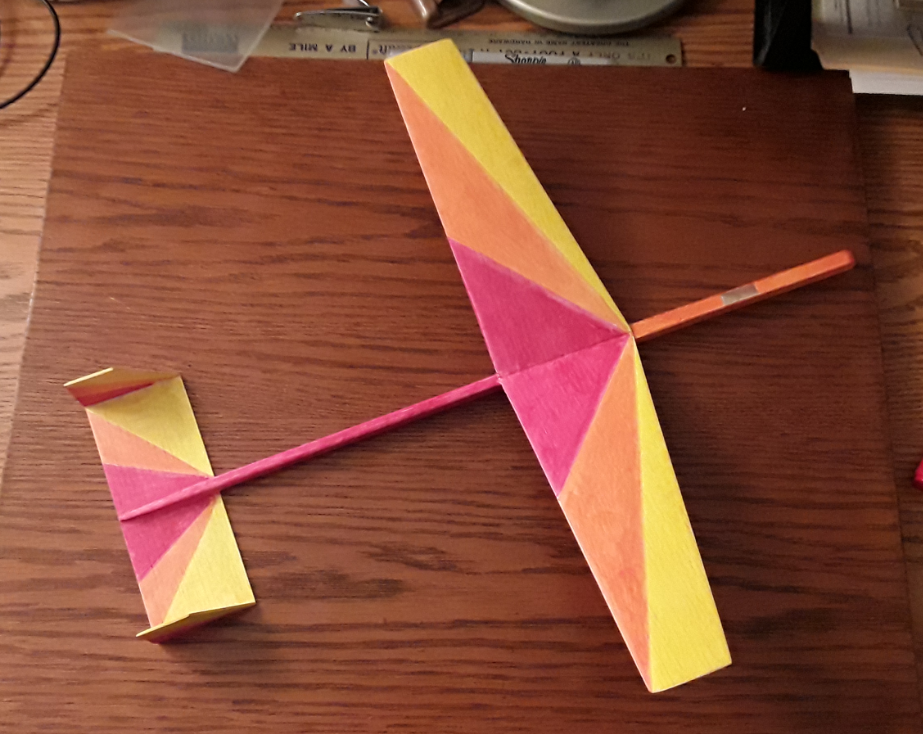
Today, I took the glider back out to the field again.  Wind speeds ranged from 0 - 5 mph, so it was a perfect time to perform trim flights.

After getting the model to trim out into a flat glide pattern, I found that I needed to introduce a turn.  The proper amount of clay on the right wingtip took care of this.


Hand launch flights typically lasted from 10 to 15 seconds.

Here are some still shots from a cel phone video I took of one of the flights:


Flattening out... (It's a FlatCat, right?)

 
Gliding......


Still Gliding.....


....And skimming the turf prior to a soft landing!

FlatCat trim test assessment:  IT GLID REAL GOOD!

The only items left with this build is to paint and apply markings to the pop-pod, install the recovery system, and trim the entire model for boost stability.
 
I can hardly wait to get this one out for a powered flight!


Tuesday, August 21, 2018

FlatCat Boost/Glider Build, Part 11 - Oops! I Goofed Up...

Yep, I kinda got a couple things out of order.

I should have applied the silver trim Monokote strips to the wings before drawing the FlatCat logo.


Turns out, the trim covers up part of the design.


Can't fix it now...just have to live with it as is.
Is it just me, or does the cat in the logo seem to have sort of a smirk on its face that says, "You Idiot!"?

Here is the now completed glider, along with a serving of the 'Breakfast of Champions". 


I probably should have drank that before starting on the markings and trim work!

Anyway, my senior moment aside, the model is now ready to take out to a convenient field and work on glide trimming.  As can be seen in the above photos, I've already applied trim clay to set the glide CG at about wing midpoint.

Monday, August 20, 2018

Maiden Flight of the Mark II Rock-A-Chute

For this post, I thought I would back-track a couple of years to November 3rd, 2016, the day of the maiden flight of the Mark II.  This is the same bird I took with me to the NAR Reunion in Pueblo and had on display along with its old-school launcher.

I had actually posted this flight as part of the 'Launch Date' series on the first version of this blog.  I had to take the blog down later that winter, and, unfortunately lost all the posts in the internet 'abyss'.

On this particular date, I had contacted fellow Denver model rocketeer Mike Goss, and we met to conduct a launch session at Dove Valley Park in Arapahoe, Colorado. (A suburb of Denver).

Mike kindly took the following photo of me posing with the Mark II.


I made the decision to post these pictures in black and white since this is a launch of a 1950s model rocket.  I had entertained the idea of arriving at the launch field dressed in 1950s style garb, but I opted out.  I didn't even put any white tape on the corner of my reading glasses I usually wear.

Oh, well ...I'm nerdy enough as it is....

Here is a pre-flight 'glamour' shot of the Mark II on the pad.  The high tech launcher is a block of 2 x 8 wood with a 5/16 diameter wooden dowel launch rod.  The blast deflector is a sheet of roof flashing cut and bent to shape.  Old school as you can get. 


And... Lift off!


A nice straight up flight of a big launch lug with a model rocket attached to it! 

Incidentally, the launch lug on this model is the casing of the very motor used to propel my first BAR-era model rocket flight a couple of months earlier.

The Mark II turned in a very nice flight on an A10 motor, and was recovered via a 15" red plastic square parachute, just the way Orville flew em'.


I had so much fun with the Mark II that I quickly re-prepped and flew it a second time.  Again a perfect flight.

Here's the Mark II in living color:


To date the model has flown 3 times, with plenty more flights to go...

Thursday, August 16, 2018

FlatCat Boost/Glider Build, Part 10 - Decorative Embellishments

To finish off the glider details, I hand drew a rendition of the famous FlatCat logo, along with the model's fleet number and my old NAR number.


Next, it's off to the park to do a little glide trimming....

Wednesday, August 15, 2018

NAR 60 Year Reunion, Part 17 - Wrapping Things Up

Well, boys and girls,

This post pretty much completes the series on the NAR 60th Year Rocketeer Reunion.  I had nearly as much fun writing and putting together this material as I had attending the reunion. I hope you all found it informative and entertaining. 

There were at least 200 NAR model rocketeers present at this event. 

Many old-timers and many newcomers.  Past NAR presidents.  NARAM contest directors.  NARAM champions.  Model Rocketry Royalty.  Hobby innovators. Rocketeers who wrote many articles or were otherwise featured in the pages of Model Rocketry Magazine and the Model Rocketeer during the roaring heyday of the hobby when the Apollo program was the going thing in the late 60s-early 70s.  Model Rocket Manufacturers from companies defunct to new ones to ones that have been in existence from near the very beginning. Fliers of LPR...MPR...HPR.  Sport fliers.  Competition Fliers. Glider Fliers.  Scale Nuts.  Oddroc Fans (won't mention any names, Randall). 

Attendee NAR numbers ranged from 18, (Bob Kaplow) to 105584, (Dave Hutchinson).

A tremendous cross section of people who at some point in their lives got bit really hard by the 'Model Rocketry Bug', and never looked in the rearview mirror.  

The core of the hobby.

As NAR President John Hochheimer pointed out, "This is the last time this same group of people will all be together in the same room representing our great hobby!"

I felt extremely privileged to be there and somewhat in awe of the whole affair.

One last anecdote:

Nearing the closing moments of this highly enjoyable and inspiring event, I caught up with fellow blogger, Hans Chris Michielssen.

"Man, this was great! It's just like being a kid in a candy store!", I said.

"Yep", replied Chris, "I feel like I'm 13 again!"

Thanks for reading!

Cheers!

NAR 60 Year Reunion, Part 16 - The Museum of Flight Silent Auction

The final presentation of the evening was given by Pat Fitzpatrick and Geoff Nunn on the subject of the Museum of Flight in Seattle.
Brief updates were discussed concerning the monumental task of sorting and cataloguing the vast amount of material, particularly the Stine, Estes, and Piester collections.

As a fund raising effort for the museum, some very neat items were donated for a silent auction held at the reunion.

The highlight piece was this set of the first three Estes Industries kits:  The Scout, Mark, and Space
Plane, donated by Vern and Gleda Estes.  The set is attractively mounted and framed and signed by Vern and Gleda.  (Sorry about the fuzzy photo).


Another item of interest was this famous first edition Estes catalog, # 261, the one that was stitched by Gleda on her sewing machine.  The frame includes a photo of that process.


This next item is one that any rocketeer would be thrilled to have hanging on the wall of their shop:
A canvas print of the box art for the Centuri Laser-X.  What a beautiful rendition!  This was donated by Lee Piester.


Several other canvas prints were up for auction at the event.  These were full color renditions of some famous early model rocket poster/box art, and others were of previous edition Handbook of Model Rocketry covers.  Unfortunately, the photo I took of them was too blurry to post here.

FlatCat Boost/ Glider Build, Part 9 - Makin' The Glider All 'Purty'

To start off with finishing the FlatCat, I hit it with a light coat of white sandable automotive primer. 
This is more for sealing the grain and providing a better surface after sanding for coloring the model with permanent markers. 
The trim weight cavity in the glider's nose made a perfect place to insert a dowel to hold the model for drying.


The FlatCat's primer coat is now dry, and all the surfaces get a finish sanding with 400-600 grit paper.
Now I can begin layout of my chosen décor pattern and applying the marker color coats:

YELLOW....


ORANGE....


 RED....


...and BLACK for the bottom side of the wings and horizontal stab.


The downside of coloring a wood model with markers is that it is nearly impossible to get neat, even color coverage.  There will always be marker streaks and mottling.  On a boost/glider, aesthetic appearance is the trade-off for having a light weight finish.  Still, it doesn't look too terrible.