Saturday, April 22, 2017

Back In The Day, Part 3 - A Man of Many Boost Gliders


In looking through the scrap book of photos and flight log records spanning my early years in the wonderful hobby of model rocketry, I found that a good number of my model fleet consisted of boost gliders or models with a gliding component. A full 25% of them, in fact!

The majority of these gliding birds were built for NAR competition events. Many were of my own design.   I experimented with nearly all aspects of boost glider technology prevalent in the day – standard front engine pop pods, variable geometry rocket/gliders, parasite gliders, ejectable flex wings, you name it.  There were even a couple of commercial sport glider models thrown into the mix:  an Orbital Transport, a Scissorwing Transport, and an MPC Lunar Patrol.   The only variety of boost/glider I didn’t build was a rear engine Space-Plane-type model. That design was pretty much passe by the time I started diving into serious B/G competition.
This collection of gliders ran the gamut of various degrees of success.  Some crashed and burned on their first flight, while others performed wonderfully.  Some glided like streamlined bricks, while others fluttered like feathers. A couple were lost to engine CATOs right on the launch pad.  There were a few ‘Red Barons’.  The best ones were lost when they were ‘thermaled’ away into the wild blue beyonder, never to be seen again.  A few even won some meet ribbons and garnered NAR contest points.
For me, this whole collection of balsa, spruce, plywood, and sheet plastic represented one of the most gratifying facets of model rocketry.  There is nothing quite like the sight of a well-built glider model climbing straight up, separating, and wheeling in lazy circles.

Today, as a Born Again Rocketeer, I have so far limited my new model rocket fleet to small, 13mm-powered standard birds, but I have been certainly eyeballing a lot of boost/glider models, designs both past and present.  Since my first BAR boost/glider just recently came off the work bench,  I thought I would post a montage of some of my ‘old fleet’ B/Gs and R/Gs.  Most likely, some of my future rocket projects will be re-makes of some of these old glider faves from years ago (1975-1984).
Oh, and I think it’s high time that I get around to building that Space Plane, too…..


Thursday, April 20, 2017

BAR Rocket Fleet #109 Mini-Maggot 3


An Old Favorite


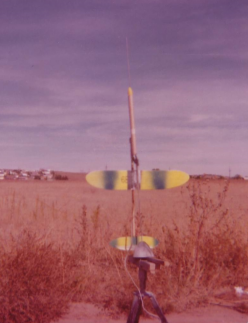
The original Mini-Maggot in 1975
The Mini Maggot 3 is a BAR era re-build of a pair of custom designed boost gliders built in

1975-1977 for competition in the ¼ A and ½ A engine classes.  

The original old-fleet Mini-Maggot proved to be a good performing model, turning in several flights.  The model’s best performance occurred on 20 February, 1977.  Boosted by a 1/4A engine, the glider transitioned well and promptly flew into a thermal.  It posted a very respectable time of 64 seconds.

The model was later sold along with most of the model collection in 1985 as part of my exit from model rocketry.


 Another version of the Mini Maggot was built in 1977, which utilized styrofoam wings.  Flown in parasite configuration on a standard booster rocket, the glider did not survive its maiden flight.

The Mini-Maggot 2 in 1977.  Flown as a parasite on a
standard rocket, the tandem pranged. 
That's me n' my old 1957 Dodge Coronet in the
background in the photo at left.


The Mini-Maggot 3 is built nearly identically to its 42-year predecessor.  Dimensions were taken from the above photograph of the original model.


The glider’s wings and tail section are made from 1/16 C-grain balsa, and the fuselage is basswood.  The pod hook enclosure is made from 1/32 thick plywood.

Finish on the glider consists of one coat of white Dupli-Color primer, well sanded.  The color coats and markings are rendered with Sharpie markers.  


The pop-pod is of standard BT-5 construction finished with primer, Testor’s International Orange enamel, and ‘gloss sauce’.

This model is probably the closest to any kind of a contest-grade model rocket anticipated to be built during the BAR era. 


Friday, April 7, 2017

MPC Lunar Patrol, Part 5

Today's post covers some progress on three different sections of the model.

1. Gliders - The wing elevators have now been attached to give the gliders a little negative incidence.  As soon as the joints are cleaned up and smoothed out, the wings will get a final overall finish sanding.

2.  A small balsa standoff is glued to the body aft of one of the fin assemblies and a seam-filled launch lug is glued into position.  Looks like the fin received a couple of small 'construction dings' just to the left of the launch lug.  Must break out the CWF.


3. A balsa block is cut to rough size and mounted on the wood lathe's faceplate in preparation for turning out the glider nose cones.  Even though the stock is trickier to mount, I prefer face turning  over spindle turning on nose cones because they can be finished right to the tips. 
Here, a piece of scrap 1x4 pine is centered and screwed to the faceplate, and the balsa stock is center glued to this piece.  The plan is to turn each nose cone one at a time out of the same piece of stock.


The stock is now mounted on the lathe, ready to go.  There's an old woodturner's / woodcarver's adage that applies here: 
"Turning / carving a [nose cone] is quite simple.  You just grab a chunk o' wood and remove all the parts that don't look like a [nose cone]."


Were it that easy....

By the way, while I'm here, I just have to show off the fancy-shmancy stand I built for my lathe a couple of years ago.  This bit of shop furniture was constructed completely using vintage hand tools, i.e., hand saws, hand planes, brace & bit, and files.  Not a single operation done with sacrificial electrons.


Let me tell you, hand-shaping dimensional 2x lumber is quite the physical workout!  That's why I call them 'Armstrong' tools....

Tuesday, April 4, 2017

Documentation Is Everything


One of the very first things I did at the outset of BAR-dom in early 2016 was to peruse through the notebooks full of flight records and photographs from the old 1973-1984 model rocket fleet.

It became quickly apparent that I had done an appallingly poor job of documenting my model rocketry activities back in the old days.  Flight logs were spotty and incomplete, photographs or drawings of many models were not in existence, and some models did not even have recorded descriptions of what type of rocket they were.

For several months, I sifted through all of this material while writing up descriptive pages about the models on the PC.  This was a very painstaking, slow process, at best.

The flight logs I had on hand consisted of spiral notebooks that contained little more than hand scrawled notes of launch dates, engines / recovery systems used, and a short blurb about the flight performance. Notebooks for three of the years of my involvement in model rocketry were completely missing.

Perhaps the most helpful documentation I kept were yearly lists of my current collection, with tick-marks next to the model names and numbers denoting how many flights each model made that year.  Models that had been lost or destroyed had a brief notation and date.

Information of some undocumented flight were gleaned from the pages of the newsletter of the club to which I belonged, which luckily carried write-ups about club launches.

Other bits of flight information were found on the backs of award ribbons I had won at various contests.

Since I didn’t own a decent camera until around 1979, there were very few photographs of my earlier models.

Despite all of this, I now have a very organized notebook of ‘old fleet’ documentation with as much information and illustrations of each model that could be found. 

Things are much different now in the BAR era, thanks to technology. 

Any number of images and videos can be taken of the new model fleet using the cel phone camera.  Contrast this to the old days when we had to snap pictures of our rockets with film cameras, and wait for film processing, not knowing if our photos were going to be any good or not.

Computers and printers now make for an easy task of writing up nice flight logs and data spreadsheets.

With all of these tools, the BlastFromThePast documentation process is much more organized and comprehensive.  There will now be plenty of data and historical info on hand for this cat!

I now produce good write-ups complete with lots of illustrations for each model in my collection as soon as it is built.  These are essentially the ones that get published here on the blog.

Comprehensive flight logs are kept for each and every launch, and include an accompanying photograph.  These logs document all of the mission data like date, location, time, weather conditions, launch details, etc.  Here is a sample:


A less formal editorial-style ‘article’ is also written up for each launch session.  These are the ones that appear as “Launch Dates” in this blog.

I also keep a running spreadsheet of engine inventories.

The only thing I still do the old school way is a yearly hand-written model list with the launch ‘tick-marks’….

Thursday, March 30, 2017

Launch Date: 30 March, 2017


Today’s weather forecast for the front range of Colorado called for temperatures in the low sixties and minimal wind, being the only nice day between Spring snow storms.  I deemed it necessary to get in a ‘rocket fix’ while the conditions were so favorable.

                The soccer fields at Dove valley were in excellent shape when I arrived at around 11:30 a.m.  Temperature was at 61 degrees and winds held around 5-7 mph.  The conditions were very clear with some high cloud cover.

                The first model to be prepped and off the pad was, of course, the Hornet.  The bird turned in yet another pristine flight on an A3-4T engine, with recovery via 1.75” x 24” crepe streamer.  The model took a little bit of a hard landing around 50 feet from the pad, breaking one of its fins off.  A minor fix.


Next up was the Rock-A-Chute Mark II clone on an A10-3T engine.  Again, the model was launched from its specially built ‘retro’ launch pad consisting of a 5/16” wood dowel rod stuck in a board.

To my chagrin, I found that my range box was lacking the usual roll of masking tape and clothespins. 

Darn it, I was using both items for some workbench builds the other day….

Since the engine is friction fit, I had to put on my McGyver hat…

I found a good work-around when I discovered that the white tape strips on the ignit…I mean, starters, would serve adequately as engine friction tape.   The absence of a clothespin meant that I had to bend a paper clip around the launch rod to hold the Mark II off the blast deflector.

All worked fine and the model lifted off perfectly, reached altitude, and deployed its 15” square red parachute for a slow, steady descent.


The next vehicle to go on the pad was an experimental two-stage affair.  The test booster employed air gap staging, and the second stage consisted of the Centuri Star Trooper.  The distance between the two engines is identical to that of a BT-20 based WAC-Corporal and Tiny Tim tandem which is on my future build list.  I wanted to to see if the staging would work using simpler models before attempting to build the more involved scaler.

It didn’t.

The A10-0T was simply too far away to ignite the upper stage.   The ‘flight’ was rather comical as the finless booster was taped to the launch rod.  After first stage ignition, the trooper got ‘boosted’ about two-thirds of the way up the rod, only to slide back down.

Oh, well….It was worth a try…..


After that, I stuck an igniter…I mean, starter… into the Trooper’s 1/2A3-4T engine to send it aloft for a single-stage flight.   The model boosted high and straight, only to not deploy its streamer.  Upon recovery, I found that the engine had ejected, the nose cone had come off, but the wadding, streamer, and shock cord were still inside the body.  The model came down pretty quickly, but sustained no damage.  Apparently, I had not used quite enough of the igniter…I mean, starter…tape to properly friction fit the engine.


With that done, I decided not to push my luck any further. Settling for one perfect flight and one broken fin, it was time to pack up and head home. 


Back In The Day, Part 1


This is kind of a long post, so please bear with me.  It is an exciting(?) account of my initial introduction and involvement in this wonderful hobby of Space Modeling....
INTRODUCING: MODEL ROCKETRY

My first ever exposure to the hobby of model rocketry happened in 1969.  I was a nerdy 13 year old, going through all the usual difficulties of the time for guys in their early teens.  I happened to be buddies with the kid who lived across the street, Marc K.

 I perceived Marc as being even nerdier than myself.  He was very science minded and focused on everything he did. His father was a colonel in the Air Force, so, naturally Marc always had the adequate monetary resources for funding his various hobby interests.  Model rocketry was one of them.

One hot afternoon in August of 1969, Marc invited me to come along with he and his dad to go see a model rocket contest being held that week on the grounds of the United States Air Force Academy. This event was called NARAM-11, a national annual championship meet attended by model rocket enthusiasts from across the country.

I was instantly smitten by seeing all of these really cool, colorful model rockets, and watching them ascend to astounding heights, deploy a bright parachute, and drift back to the ground.

I had put together many plastic static display models over the years, but had never encountered anything like these model rockets. They actual did something...they flew, just like real rockets!  They didn’t get built just to sit on a shelf and collect dust.

 I didn’t know it at the time, but I was watching some of the biggest names associated with the hobby  – many of them pioneers of model rocketry that I would later read about in the hobby magazines, and a few that I would actually get to meet later on.

I also became familiar with the names of Estes Industries and Centuri Engineering, the two most prominent rocket manufacturers present at the event.   I obtained copies of their 1969 product catalogs from their vendor booths as well as the official program of NARAM-11.  I still have these.

Keeping in mind that 1969 was the height of the Apollo Space Program, culminating with men landing on the moon that year, a hobby that involved working model rockets was bound to be all the rage.

Following the visit to NARAM-11, I went home with all of that intriguing reading material in hand.  I pored over the pages of those catalogs, marveling at all of the cool rocket kits being offered – from tiny featherweight models all the way up to the mighty Saturn V !!  I digested all of the technical sections in the catalogs, describing how the models were constructed, the engines that made them go, how they flew, and were recovered.  Marc also lent me his copies of Model Rocketry Magazine.

Hooked!

In those days, I didn’t have an allowance or any other form of monetary income to permit me to purchase model rockets, so I had to be content with accompanying Marc to participate in launching his models.  At home, I even went as far as to construct my own parachutes out of plastic bread bags.  I recall many evenings spent out in the street in front of my house, rolling up these home-made ‘chutes, tossing them into the air as high as I could, using metal washers as the weights suspended under them, constantly tweaking and making adjustments to optimize their performance.  This may all sound goofy, but the exercise proved to be very valuable experience for what was to come….

MODEL ROCKET BABY STEPS

Fast forward to 1973.  By this time I was a nerdy high school junior, going through all of the usual difficulties of the time for guys in their upper teens.  Only now, I held a part-time job and could afford to spend some money on model rockets (and Uriah Heep albums!).

Accompanied by Marc K., I visited a hobby shop in Colorado Springs called Jack Aycock’s Custom Hobbies.  This store catered mostly to the R/C airplane crowd, but Jack carried a respectable supply of model rockets and accessories.  To me, it was like being in a candy store!  Atop one of the shelves stood an already built model rocket – an Estes ‘Mini-Brute’ Hornet that one of the store employees had put together.  Marc suggested that I buy that model and use it to get my feet wet with launching a rocket.  I followed his advice and bought the rocket for around $1.50, along with an Estes Mosquito kit, an older Starblazer kit, and some engines.   I still have that Hornet.

SKYWATCHERS / ROMAR

Once I had built some models of my own and had some rocket-flying experience under my belt, it was time to take the next step.   Marc invited me to come along with him to a meeting of a local model rocket club that was just being organized – The Skywatchers Rocket Club.

Initially, this group consisted of about five or six members, mostly guys in their late twenties or older. The core of the club consisted of Lester and Barb Coburn, Glade and Lillian Gordon, and Frank Gee.  Marc and I joined the club and began participating in launch meets, public demonstration launches at shopping centers, and meetings.  Since I had taken some advanced English and Creative Writing classes in high school, I was appointed as the editor of the club’s newsletter, The Cosmic Steppingstone.  I remained in that role on and off over the next ten years, up until the club ceased to exist in 1984.

In early 1974, the Skywatchers gained sanction as an NAR section, the Rocky Mountain Association of Rocketry (ROMAR), Section # 331.    At the same time, I became an NAR member myself (#25180). 

Things literally ‘took off’ at this point.  Bill Roe, one of the founding pioneers of the hobby, generously donated to the club most of the launch and range equipment that had been used by the Peak City NAR section in the 1960s.  This consisted of launch racks, a central launch controller, communications and PA systems, and tracking theodolites.   The Skywatchers/ROMAR club at this time was using a large empty field on Airport Road roughly ¾ of a mile east of Academy Boulevard in Colorado Springs. It’s ironic that the second home I later owned was part of a residential area built on the site of the down-range area of this very same flying field!  I often wondered if the remains of some of my old long-lost model rockets were unearthed by the construction crews.

 I recall one Sunday shortly after obtaining all of that range equipment, all of us club members spent a day at the field and, instead of flying rockets, trenched in permanent phone lines connecting the designated launch area and the tracking station locations.

Once things were set up and organized, Skywatchers/ROMAR began holding regular launches every other Sunday.  Interspersed with sport meets were some of the club’s first NAR-sanctioned contests and organized demonstration launches at local shopping centers and parks.  At that time, ROMAR interacted with a couple of other front range clubs:  a group in Pueblo (PAR) led by Lloyd Armstrong, and the “Rapirhawks”, another Colorado Springs club led by Warren Layfield.  (At this writing, Warren is still active as ‘Senior Advisor’ in a modern Colorado Springs club – COSROCS).

Up until mid-1974, club meetings were held in the back room at Jack Aycock’s Custom Hobbies store.  Not long afterward, Jack retired and sold the shop, so ROMAR was left to find another meeting place.  This happened in the form of being able to use the Hillside Community Center on South Wahsatch St. in Colorado Springs.

THE EARLY DAYS

As for my own rocketry activity, I began small with the building of an Estes Mosquito kit.  This tiny rocket was promptly lost after its first flight, a common problem with Mosquitos!   

I did happen to find the model a couple of days after its flight.  It was sitting in the middle of a motorcycle trail adjacent to the launch field – crushed to smithereens!  Not even the nose cone was salvageable.

To this day, the Mosquito kit is still being produced by Estes, and modern-era model rocketeers consider it a sort of ‘right-of-passage’ to fly one of these diminutive birds and actually recover it afterwards.   I built three of them in my previous rocketry career, and yet another is on the docket for the post-2015 BAR era!  I should know better, but they are fun little rockets!

My second rocket was an Estes Starblazer – the older K-31 kit that was originally designed for ‘Short’ engines, then converted to fly on ‘Mini’ engines when those first came out. This one was a fun rocket to launch, but was eventually lost at the infamous Limon demo (read more about that later).

After a couple more small Estes kits, I got into building birds of my own design.  This was all driven by club competition, which became a major facet of my rocket building activity.  I’ve never counted, but I would wager that well over 60% of the model rockets I built between 1973 and 1983 were for competition purposes. The vast majority of them were custom designed.

It wasn’t long before I was trying out all aspects of model rocketry in addition to competition:  multi-staging, clustering, D-Engine models, aerial photography (Cineroc and AstroCam), boost/gliders, egg-lofting, helicopter recovery, sci-fi models, and even a couple of scale birds.  The two most prominent of these were both Centuri Engineering kits: an IQSY tomahawk and an Apollo Little Joe II.

I also began ordering and building kits from rocket manufacturers other than Estes – namely MPC (Model Products Corporation), CMR (Competition Model Rockets), and MRI.  Strangely enough, I never built or owned a rocket from Flight Systems, Inc. (FSI).  This company was known for its higher powered E and F class engines and kits.  Other members of the Skywatchers club flew these, and they were very impressive models and engines!

I think my all-time favorite model in the collection was an MPC kit – the Lunar Patrol.  This interesting bird consisted of a core booster that carried two detachable delta-wing gliders. Once these were trimmed for efficient glide, the model was very fun to watch – the entire model boosting straight and high, the gliders detaching at ejection, and the booster wafting down on its parachute, while the gliders wheeled around overhead.  Actually, the original booster was destroyed on its first launch attempt by a defective engine, so I re-designed a replacement version that was flown several times.  I wish I still had that rocket.  A plan to build a BAR clone of the Lunar Patrol is definitely on the upcoming schedule.

There were a couple of other model rockets in the old collection that stand out as being some of my favorites to fly.

Remember the Mosquito?  Prompted by a contest event called Maxi-Scale, I ended up building a 3X sized version of the little bird.  Maxi-Scale was where one would take an existing rocket kit and build a larger ‘scale’ rendition of it.

Powered by a mighty D engine, the ‘Skeeter Eeter’ would scream skyward to a very respectable altitude, and come down on a streamer.  The first version of a Skeeter Eeter was lost at the Limon Demo, so a second was later built, this one using standard 18mm engines.  Even on lower impulse power, it was still a very impressive performer.

Another of my favorite models was the Estes A-20 Demon, a kit model designed to fly on a D engine as well. The Demon was a very attractive rocket which never failed to turn in an impressive flight.
Stay tuned for Part 2......