Monday, June 14, 2021

Launch Date: June 14, 2021

 Today, I once again made the short hop to Douglas County High School for another of my 7 a.m. 'shoe box' rocket launch sessions. This is my third such event over a span of four days.

This morning's weather was absolutely ideal - 75 degrees and virtually no wind.

Today, I left the EAC Viper flagship at home in favor of putting up another keychain video camera flight as well as another of my earlier models that hasn't been flown in awhile.

The carrier rocket for the camera was the Quest Big Rage.  This model seems to have become the workhorse for handling all of these video flights.

Powered by a B6-4 motor the model boosted very nicely to an estimated 300-350 foot altitude.  At ejection the parachute deployed fully and brought the model in to land about twenty feet from the launch pad. 

The second flight of the session went to the diminutive Star Seeker.  This was one of the three rockets in the long ago Estes Mini-Tri-Pac kit.  I built it a few years ago because I just like the design.

Flying on a 1/2A3-4T motor, the Seeker boosted surprisingly high.  Once again, I was elated to see its little 6 inch parachute deploy and bring it in for a safe landing, again quite close to the launch pad. I resorted to using a parachute because the model's previous flights relied on either break-apart or streamer recovery, and always ended up with one or both of the fragile fin assemblies breaking off.  This time the model landed intact.

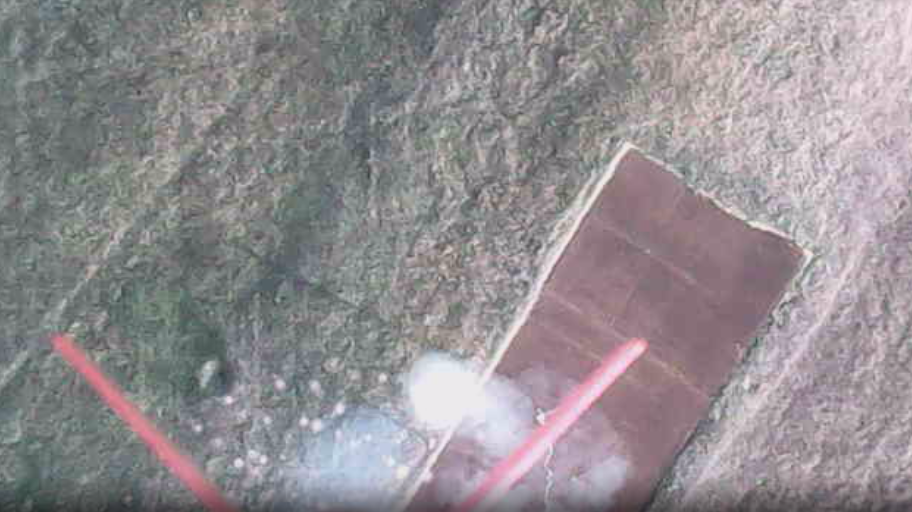
After I got home, I connected the keychain cam to the ol' PC to check out the flight video.  It recorded successfully, but the video was quite unremarkable.  Apparently, the ejection charge went off just before apogee, so the model didn't arc over and get any images of the horizon, or any interesting features surrounding the flying field.  The entire video consisted of aerial shots of the launch field grass. 

Here is one still frame showing the cement pad from which the model was launched:

I intend to improve this on future vid-cam flights by cobbling together a rigging system that will hold the camera at an angle under the parachute.  Lots to learn....


Sunday, June 13, 2021

Launch Date: June 13th, 2021

 Today, I took advantage of some warm, windless weather conditions to slip out and fly a couple of model rockets at the Douglas County High School practice field.  My wife accompanied me on this venture, enjoying the benefit of setting up her lawn chair in the shade of a small tree right next to the launch pad. 

The first model on the launcher was the EAC Viper.  

After an initial launch failure - the igniter wires were crossed - the bird turned in a very nice flight on an A10-3T motor.  

At ejection, the parachute stuck together, but finally caught air and deployed fully when the model had fallen to about fifty feet above the turf.  The model landed twenty feet away from the launch pad and was recovered intact. 

Next up was the Griffin-2 custom rocket.  For this flight the model was equipped with a payload bay designed to carry dual altimeters for comparison test purposes:  the Estes version and a FlightSketch Mini.

The model launched nice and straight on a B6-4 motor.  Again, the model experienced a para-wad.  I seem to be plagued with these things recently, even though great care is taken in powdering and packing the devices. 

Despite this, the model landed nearby without sustaining any airframe damage. 

The Estes altimeter returned a reading of 396 feet, while the FlightSketch recorded 362.5 feet. That's a difference of 34 feet. There still may be issues with the Estes unit involving introducing a small amount of air pressure during the process of loading the device into the payload bay. 

This problem doesn't occur with the FlightSketch, because the device is armed remotely after the unit has already been packed into the payload bay.  More such tests are planned for the near future.

Anyway, I was delighted to obtain a good data download from the Mini.  

And, I was equally delighted to get another short flying session accomplished!


Friday, June 11, 2021

Launch Date: June 11, 2021

 Over the past few weeks in Castle Rock, there has been a considerable amount of constant windy conditions present on a daily basis.  I began observing that, on most days, it is fairly calm in the early morning hours. 

 I am now back in the habit of working out at the local recreation center early every weekday morning, and since the facility is right next door to the High School practice field from which I often like to launch rockets, I have made the determination to pack a couple of models along and stop by the field after my morning workouts for a mini-launch whenever the conditions are favorable.

 Today was such a session.  Winds were variable between 2 to 7 mph, temperature was around 55 degrees, and conditions were quite clear.

 The first bird to leave the pad was the EAC Viper flagship, flying on A10-3T power.  The model boosted nicely to around 200 feet, but the parachute failed to deploy fully, despite being well-powdered. The model sustained no damage and was recovered intact. 


The second flight of the session was made with the newly-built Quest Nike-K for its maiden launch.  Flying on a B6-4 motor, the model turned in a good performance.  Ejection occurred after the model had reached apogee and was headed downward.  Its next launch might benefit from a motor with a shorter delay.

The Nike’s parachute deployed nicely, and the model landed safely well within the bounds of the field.

 All in all, this short ‘shoe box’ launch session was very satisfying. I plan to be doing many more of these in the near future. It’s a great way to catch up on logging some flights on several models that were missed during the 2020 pandemic year.

Cheers!

Tuesday, June 1, 2021

Back In The Day, Part 44 - Another Newsletter - "The Rocket Mountain News"

 This is a small newsletter I began publishing shortly after I was appointed as NAR Mountain States Region Manager.


The newsletter was intended to be sent to all NAR members residing in those states as sort of a regular update of what was happening in the region.

This premier issue is the only one I recall printing up and distributing....

One item of note here is the small blurb about veteran  rocketeer Gary Price receiving the appointment of Utah's State Department Head.

Later on, Steve Sande of Denver was appointed Colorado's SDH.

Another item is the short article about the HOTROC-1 Open meet.  I erroneously typed ROMAR's section number as 103.  Should'a been Section 331 !

Wednesday, May 26, 2021

Back In The Day, Part 43 - One More Cosmic SteppingStone Tidbit...

 In the very back of my Cosmic Steppingstone newsletter notebook binder, I found this interesting original hand-drawn concept cover page...


At some point around 1983, I had apparently entertained the idea of putting together a small "Best Of..." volume containing the better articles, cartoons, rocket plans, and various items of interest that had been published throughout the history of the newsletter.

Obviously, I never got around to doing that.

But, now, come to think of it.....it's never too late for anything.

Perhaps in the near future, I will pick up this long-forgotten project and finally complete it...38 years after its inception.

I'll be sure to make it available to anyone who might care to download a copy.

Tuesday, May 18, 2021

...And The Build Pile Just Gets Bigger...

In a recent post, I promised I would treat myself by buying a couple of new kits as a BAR birthday present to me.

Today, I made good on that promise by taking a trip to the local Hobby Lobby.

I ended up walking away with not a couple - not three - but four new additions to the stash.

Three of the kits are strictly earmarked as parts sources for other projects:

The Mean Machine and Baby Bertha are destined to become Big Bertha, Omega and Astron Spaceman clones, three of my 'old fleet' favorites.  

This is after all, the BlastFromThePAST Blog. 

The remaining body tube pieces will likely become various booster stages and payload sections.

The Cherokee-E was purchased mainly for the body tube to replace a BT-55 that came in a Nike-X kit in damaged condition. The leftover usable body sections will also be cobbled into boosters and payload tubes.

Only the  Crossfire ISX kit will be built as originally intended.

It's simply a cool looking design...

Saturday, May 15, 2021

Launch Date: May 13th, 2021

 Today's launch on Thursday, May 13th, was a rather impromptu affair based on some weather condition model analysis of the Castle Rock, Colorado area observed over the past two days.  Founders Park, the site of the previous week's ill-fated launch attempt, was the chosen site.  A couple of fellow area rocketeers were notified of the mini-event, but Jim Gazur was the only one able to attend.

I arrived at the field at 12:00 noon to get set up and start flying some birds.  The wind was variable, ranging from 2 to 9 mph.  With the park located on top of a mesa, the winds tend to change direction frequently, making it difficult to ascertain an optimum launch location right away.  

Jim was not scheduled to arrive until 12:30, so I went ahead and prepped the flagship EAC Viper for flight.

The model flew very nicely on A10 power, but the parachute failed to deploy, causing a fairly hard landing on the turf downrange.  No damage was incurred by the model, however.

My second model sent aloft was the Estes Super Shot, the late 1990s version, for its maiden flight.  Since I wasn't entirely sure about wind drift conditions yet, I put this one up on an A8-3 motor.  The Super Shot is a fairly heavy mostly-plastic bird, so altitude was limited to the 150-200 foot range. The model landed nicely, and was picked up by Jim, who had just arrived, and was approaching directly in the flight line of the model.


I'm somewhat curious as to what that object appearing in the image to the left of the smoke trail is. It definitely is not part of the model or launcher.....

Jim had brought only one model to fly - the Dual Deployment Test bird that had lawn darted at Dove Valley on April 30th. The bird was repaired and ready for another test flight.  While Jim went back to the parking lot to do some flight prep work at his car, I took the opportunity to trim out the Orbital Transport glider.  After several tosses and trim clay adjustments, I finally had it flattening out for a satisfactory glide. 

At least it flew well enough to earn my standard 'redneck' badge of approval:

While Jim was still away, I moved launch operations a bit further upwind to provide more field for some of our upcoming higher impulse flights to land in. This placed me in the general vicinity of where I had lost my launch rod the week before.

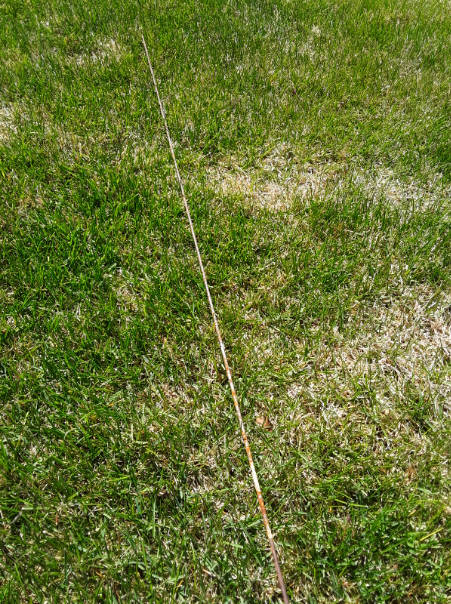
To my surprise and delight, I found the object after only about five minutes of searching. 

 It was a bit rusted from rain and dew, but is fully restorable for use again.  Besides getting the rod back in my possession, I'm very glad that some poor grounds maintenance guy didn't have to deal with running over it with a lawn mower.....

About this time, Jim had returned to the launch area and was quickly able to get his test rocket ready and on the pad.  

The model carried a load of electronics:  a Perfectflight Stratologger altimeter to record flight data and trigger the dual deploy system, the pyro release mechanism itself, and a newly acquired Estes Astrocam video camera attached to the airframe to obtain images of the recovery system deployment.

The avionics bay is situated in the middle of the model, and the aft facing charge deploys the streamer at apogee pushing out the fin can as if it were a nose cone.  The forward-facing charge deploys the parachute at the selected lower altitude determined by the altimeter.  If the avionics fail the motor's ejection charge deploys the streamer.

Upon ignition, the model boosted nicely on a D12 motor, but for some reason weather-cocked severely. 

It still reached enough altitude to allow the deployment system to work properly.  A still frame from the video below attested to successful system operation.

The entire model landed on the flying field and was successfully recovered.

My next flight was an Estes Generic E2X carrying a special payload section.  This unit was designed to carry both an Estes and FlightSketch Mini altimeter on the same flight, mostly to ascertain the accuracy of the Estes version.

Both altimeters were powered on and carefully loaded into the payload bay. The model was placed on the launcher.

True to Murphy's law, when I tried to connect to the FlightSketch with the app, it showed 'Device not found'.  After removing the altimeter, I found no power.  I couldn't get it to power on again, either. Dead as a doornail.  

The E2X flew anyway, carrying only the Estes altimeter.  On a B4-4  motor, the flight went well, albeit with another 'para-wad' recovery.

The altimeter read 376 feet, which Jim and I concurred as being in the ball park of the observed visual estimate.

The final flight of the day went to my Big Rage carrying an 808 keychain cam on a B6-4 motor.  

The model turned in a very nice flight despite experiencing yet another un-deployed parachute! That was three out of four.

I determined the problem to be from powdering the chutes the day before while pre-prepping all the models.  Even though they didn't get folded up for packing in the model box, they probably still need more powdering right before launch.

Anyway, here are some of the more interesting still frames from the Big Rage video flight..


I've included these two shots of Jim observing the model's recovery.  A couple of frames showed up in the video as the model neared the ground, and the other is from the ground-based cel phone video of the flight.. 


It's interesting to note that the 808 video field depth makes people and objects appear to be much closer than they actually are.  The video frame makes it look like the model is coming right down next to Jim when, in reality, it was well over 50 feet away.

On a final note: after I got home, I attempted to power up the FlightSketch altimeter.

It worked just fine.......

Cheers!