Monday, September 7, 2020

BAR Fleet #129 - Wasp B/G

Model Name: Wasp

Model Type: Front engine boost glider.

Designed by Marc McReynolds.  Published in Model Rocketry Magazine, Dec. 1970.

Motor Type: 18mm

Glider length: 26.7cm

Wing Span: 20.3cm

Glider weight: 8.6g

Pod length: 15.8cm

Pod diameter: 19mm

Pod weight: 6.0g

Overall model length: 35.9cm

Overall weight: 14.6g

Color scheme: Yellow and black with silver trim.

Completion date: September 7, 2020

A 50 Year Old Boost/Glider Design

The Wasp B/G is built from the plans published in the December 1970 issue of Model Rocketry Magazine.  This is my second build of the model, the first being rendered back in 1974, fleet #29.

The bird was designed for small-field boost/glider flying using 1/2A motors.  An unusual feature of the glider is the use of 1/32" balsa stock for the rudder and horizontal stabilizer.  The thin stock can be used because of the low aspect ratio of these parts.  The model employs the standard pop-pod design popular in the late 60s-early 70s.

Since the model is named the "Wasp", I deemed it appropriate to color it to look like the insect. The glider portion was rendered with yellow and black permanent markers applied over a light coat of Duplicolor white primer.  The pod is brush painted with acrylic hobby paint.

The nose used on this version of the Wasp isn't exactly that called out in the plans.  I just happened to have a conical one rattling around in the spare parts box that could be pressed into service. It will work quite nicely.

This re-build of one of my "old fleet" boost/gliders is a welcome new addition to the growing BAR collection.

Here are more pictures:


Tuesday, September 1, 2020

Back In The Day, Part 31 - Those Old Hobby Shops

In the 1970s and early 80s, the city of Colorado Springs was blessed to have several good hobby shops stocked with model rocket goodies.
I rarely had to buy rocket kits, motors, or supplies via mail order simply because we could get it all from the local brick and mortar establishments.
Such places as Custom Hobbies, Ru-Jan Party and Hobby, Levine's, Miniature World, and Hobby Hub carried everything a respectable rocketeer of that era needed.
Besides the abundant products of the popular Estes and Centuri lines, we even had access to Flight Systems, Inc. And Competition Model Rockets products right off the shelf at a couple of the local stores.
That means in a single afternoon of driving about town, one could pick up that new  Cineroc here, and a Laser-X kit there.
 Across town could be found a CMR dual egg capsule and a Manta boost/glider kit for that upcoming contest.
Oh, and maybe pick up a couple F100 motors a few miles further down the road, for that big bird at home on the workbench.
Ahh, them was the good ol' days.....

Monday, August 31, 2020

Ditch The Decor??

 Last night, I read an interesting thread in the Model Rocketry History category of Ye Olde Rocketry Forum.

The late Mike Dorffler, long-time Estes R&D designer, lamented about how many decor schemes of his kit designs were 'hi-jacked' by company management or marketing, and converted into ridiculous alternate versions.

This got me to thinking (a quite dangerous prospect at best).

Firing up the ol' PC, I pulled up PDFs of Estes catalogs from the past 30 years. Sure enough, a large number of models offered in the catalog pages possess downright gaudy and gimmicky decoration schemes.  The vast majority of these rocket models are 3/4FNC birds populating starter sets and the beginners' skill level pages, clearly targeting the younger crowd, who apparently are drawn to that sort of thing.

But then, I began examining the birds with a different perspective: looking past the overly bright decor and concentrating on the overall physical design of the models themselves.  I found that many of the designs are quite aesthetically pleasing in their own right.  Nice fin shapes, nose sections, transitions, etc.

If painted and decaled in a more traditional manner, while trashing the oftentimes garish and oversized kit name markings, many of these models could be made much more attractive - at least to a grumpy old curmudgeon such as myself...


Binge-Building At The Blastfromthepast Shop!

 Even though I have not been doing any model rocket flying as of late, things have certainly not been idle in the work shop.

The Viking re-build is complete: those flimsy card stock fins have been ripped off and replaced with sturdier basswood versions.  A little brushed-on yellow paint finished things up nicely.

The Orbital Transport received its first primer coat yesterday.

A small boost/glider project is ready for finishing.

Finally, a Citation Patriot is built and ready for primer.

Even more kits and gliders are in the build queue, as well as more progress on the Protostar.

Stay tuned....

Tuesday, August 11, 2020

Orbital Transport Update


 I finished up building the Orbiter glider today.  Next operation entails touching up random small gaps and grain.  I expect to get both parts of the model in primer this weekend.

Fun build!

Thursday, August 6, 2020

Orbital Transport Build Update


As promised in an earlier post, here is the first update of my current scratch-built OT project.
This morning, I glued on the forward canard pieces, the final two of the twenty-eight balsa parts on the booster rocket.
That's a lot of cutting, shaping, sealing, sanding, gluing, and filleting!
Aside from the huge amount of balsa parts, there are the four ram jet tubes, three launch lug pieces, two standoffs, the main tube, and the motor mount to deal with.
Back in the day, Estes gave this model a rating of Skill Level 4.
I prefer to rate it as 'Patience Level 4" instead.
Anyway, all that is left for the booster is to round off a few more fin edges, fill and sand a few gaps and residual balsa grain areas, and shoot some primer.
The parts for the orbiter glider are all cut out and ready for assembly next week. 
I greatly look forward to finishing this build and getting an Orbital Transport into the fleet.

Wednesday, July 22, 2020

Back In The Day, Part 30 - HOTROC-2

On August 22-23, 1981, 15 NAR rocketeers from around the Mountain States converged on Colorado Springs, Colorado to compete in the second annual Heart Of The Rockies model rocket contest.

By this time, ROMAR had grown to include enough members to renew its section charter, so HOTROC-2 could be flown as a Regional meet.  The WARP section of Utah was represented by Randall Redd and Gary Price, and COSMIC of Denver was represented by Steve Sande and Ken Tanaka.  

Once again, I served as Contest Director. 

Weather was ideal for most of the meet except for the interruption of a nearby severe thunderstorm on the afternoon of the first day.  We later learned that this storm had been accompanied by a tornado warning!

Events flown at the contest included:
Class B Parachute Duration
Class C Eggloft Duration
Class D Super-Roc Duration
Class A Helicopter Duration
Class C Boost/Glide
Sport Scale

The range set-up and organization was similar to the previous year's, i.e., an eight station Misfire Alley system. 

Here are some pics and other stuff that remain in my old archives from this fun event:

Randall Redd of Utah preps his B motor parachute duration entry.  PD saw several flights topping the six minute range:

The Official HOTROC- 2 jacket patch:


Me and my Class C Eggloft bird:


Contestant Tadd Jensen prepares to launch his egglofter:


Steve Sande readies his Class D Super-Roc entry:


ROMAR member Glade Gordon at Super-Roc safety check:


Liftoff of Tadd Jensen' Super-Roc:


HOTROC-2 Press Release published in the local newspaper:


Front cover of the official HOTROC-2 programme handed out to range visitors:


Me posing with my USS Explorer cluster demo model.  It flew successfully on a D12-5 with 2 B6-0 motors in the outboard fin pods:


Glade Gordon launches his  Class C B/G.  His efforts were to no avail, however, as Paul Heward took the event with a time far above all other entries:


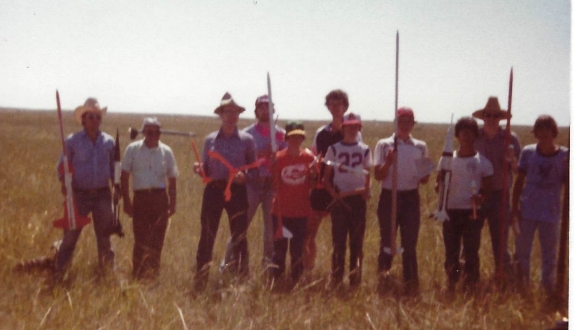
Finally, a group shot of most of the HOTROC-2 contestants holding some of their rockets. 
Far left, ROMAR's Glade Gordon poses with an upscale Laser-X and an FSI Black Brant II.
Third from left is Randall Redd with his winning Helicopter Duration bird. He posted a combined time of 2:22, which was quite excellent for the newly introduced event. Second from right is Gary Price from Utah, overall meet champion. 

All in all, HOTROC-2 was a very enjoyable, relaxed model rocket contest featuring a lot of great flights, demo launches, and comradeship.  

As the participants were leaving the field, plans were already being aired about HOTROC-3 the following year.