Friday, July 5, 2019

Steampunk Protostar, Part 29 - Finishing Up The Launch Lugs

After doing a little bit of work on the Protostar body tube, I am now turning attention back to finishing up the launch lugs.

The first order of business is to apply some CWF to the lug stand-offs.


After sanding the stand-offs smooth, its time to apply some rivet detail.

The original plan was to use sections of Avery paper with the rivets punched in, but I opted instead for the technique of carefully applying some precision-controlled drops of white glue to form the rivet heads.  I had to practice for a while on some scrap paper to get blobs of consistent size and shape.


Once the 'rivet' heads are completely dry, the launch lug assembly can be painted.

Regular old brush-on acrylic model paint will be used here.  A fine flat tipped artist's paint brush is employed for this step.

First, the lugs.  Some nice 'Steampunk' brass works here.


Once dry, the lugs are masked off and the lug 'collars' and standoffs get a coat of flat aluminum acrylic paint. Care is taken not to get any paint onto the bottom gluing surfaces.


Here are the completed launch lugs.  These will get glued on to the model after the main body tube is painted.


Wednesday, July 3, 2019

The Estes Photo Contest

OK, so I dropped the hammer earlier today and submitted a photo to this latest 'contest' sponsored by Estes.
In reading the contest description, it sounds like there will not necessarily be any judging of the submissions, rather the winners will be selected at random.
The grand prize is pretty juicy - A four kit set of models covering the U.S. manned space program - a Saturn V, an Apollo Little Joe II, a Mercury Redstone, and a Mercury Little Joe. 

Sweeeet!

The contest is very simple - all you have to do is get on the Estes website, click the contest entry box, submit your name and email address, upload a picture of yourself or a family member launching a rocket - any rocket - and hit the 'GO' button.

Hey, Presto....You're in!

"THAT'S EASY !!!!"


Good luck!

BAR Fleet #123 - Big Rage


Source: 
Quest Aerospace
Kit #1010
Type:  Sport Model

 Stages:  Single
Engine Type:  18mm
Recovery:  Parachute

Length: 
(With Payload): 93.2cm
(Without Payload):  71.7 cm
Diameter:  35mm
Weight Empty: 
(With Payload): 92.8g
(Without Payload): 77.5g

Nose Cone:  Conical
Fin Type:  Trapezoidal
Number of Fins: 4
Color Scheme: 
Dark Blue, Black, Red,
Chrome silver Trim

 Date Completed: 
28 June, 2019

 A Really Tall Nike Smoke!

 
The Big Rage was a beginners’ model produced by Quest Aerospace.  The bird features a plastic ‘scale’ Nike Smoke nose cone and plastic fin can.  The main booster body and payload section came pre-colored – blue and black respectively.  Standing a little over three feet tall, the model is very impressive looking.

 This Big Rage model came to me already built by  a friend living in Colorado Springs, Mr. Robert Antion. 

There were a few modifications and fixes necessary before the model could be deemed flight-ready and added to the fleet.  Chief among these was painting the fin can and nose cone.  The original kit parts came molded in a hideous bright pink color!  I chose to change this to a more palatable bright red.
The model also came sans launch lugs, so I had to raid my parts stash to remedy this.  Since I did not want to re-paint the entire booster section to accommodate the new lugs, I chose to color them with a blue Sharpie marker.

For safety’s sake, I also replaced the stock kit shock cord, which was a bit too short, and had been sitting in storage for over twenty years.  I like that the model is equipped with a Kevlar shock cord anchor, as do most Quest kits.  All I had to do was install a four foot, ¼ inch elastic cord to the Kevlar loop.  A heavy duty snap swivel was attached to the free end of the shock cord to allow the model to be flown with or without the payload section.

Finally, the model was embellished with some rub-on fleet number decals and a two inch wide Chrome Silver Monokote band at the top of the booster section.
The Big Rage in no-payload-section configuration

This big bird is a welcome addition to the fleet, and is destined to log a lot of flight missions as the designated carrier for a key chain video camera.


Monday, July 1, 2019

Launch Date: 30 June, 2019


Today’s launch was another ‘Shoe Box’ session conducted at Founders Park in Castle Rock, Colorado. 
Perfect flying conditions prevailed for this session with wind speeds ranging from dead calm to maybe 3 mph tops.  Temperature at launch time was near 80 degrees and the field was in perfect condition.

The first launch went to the perennial Estes Hornet.  The model rose straight up on an A3-4T motor, reached apogee and ejected the parachute, which opened instantly.  There must have been a little thermal activity going on upstairs, because the model hung for a fairly long time under a 9 inch parachute equipped with a small spill hole.  At 42 seconds after launch, the model touched down softly on the turf a short distance away.  This was perhaps the best ever performance of the Hornet in its 46 year, 46 flight history!


The next flight went to the Estes Lynx.   After a perfect straight-up boost and coast to apogee, the parachute ejected, but failed to open.  Fortunately, the model balanced so that its descent was in a horizontal attitude, so no damage occurred on the harder-than-planned landing.  The parachute failure was a bit perplexing because it was well powdered just before the flight, and was properly packed into the airframe.  Nevertheless, it was still a fun and successful flight.


Tuesday, June 25, 2019

BAR Fleet: #121 FlatCat-C


Scratch Built From Published Plans,
Designed by:  G. Harry Stine,
Type:  Boost/Glider

 Glider
Length: 41cm
Wing Span:  34cm
Weight: 18.0g

Pod
Length: 17cm
Diameter:  18.7mm
Weight: 8.3g

 Total Length: 47.5cm
Total Weight (empty): 26.3g

 Color Scheme:  Yellow, Orange, Red, Black
Trim:  Black and Chrome silver

 Date Completed:  23 May, 2019

 A Replacement Glider

The FlatCat-C was constructed to replace FlatCat-B, #117, which was lost on its maiden flight in October of 2018.

 
Construction and color scheme is identical to the previous version.  This glider will be flown using the original pop pod numbered 117.

 One minor difference from its predecessor is found in the FlatCat logo drawn on the wing.  I took a bit of cartoonists’ license to change the expression on the cat’s face!


Tuesday, June 18, 2019

BAR Fleet #122, Quark


Source:  Estes Industries
Kit #: 00802
Type:  Sport Model

 Stages: Single
Engine Type: 13mm
Recovery:  Featherweight

 Length:  13.5cm
Diameter:  13.7mm
Weight Empty:  4.4g
Nose Cone:  Tangent Ogive
Fin Type: Tapered Swept
Number of Fins: 4
Color Scheme:  White, Dark Red,
Fluorescent Red, Chrome Silver, Black Trim

 Date Completed:  15 June, 2019

 Another Tiny Model
Rocket!

 
This model came to the collection via a friend in Colorado Springs, Mr. Bob Antion.  The bird was built sometime in the mid 1990s and was never flown.

 In its original form, the model had been painted without any finish on the balsa fins, so they were rather rough.


This was remedied by sanding off the finish and applying a couple coats of CWF followed by a coat of white primer, all with fine grit sanding in between.  The body was then re-shot with white gloss enamel paint.

 Since this is a tiny, high-flying model that returns without any type of attached recovery device, I chose to apply some additional high visibility elements to the finish.
These consisted of a wrap of chrome silver adhesive Monokote which will reflect sunlight, and an application of fluorescent red on the tips of the fins for contrasting with the area in which the model would land.  The nose was left with the original dark red paint. 

I anticipate that this will be a fun little rocket to have on the display shelf and on the flying field.


Monday, June 17, 2019

"Trimmin' That Ol' 'Cat..."

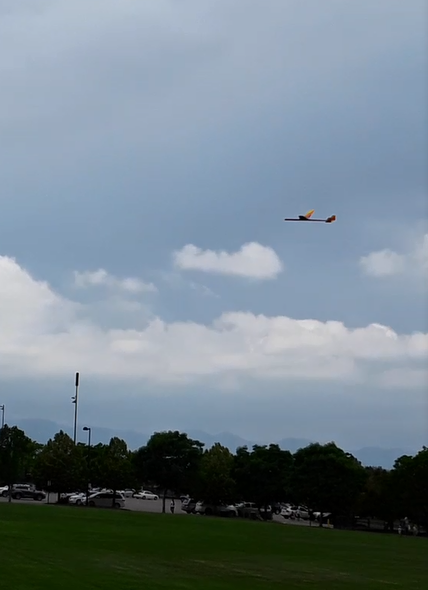
I stepped out at lunch time today to spend a few minutes at the nearby park with the new FlatCat glider getting it glide trimmed.   Weather was perfect with a minimal breeze.


The verdict:

 
Here's a pic pulled from a cel phone video of one of the test hand tosses. 
The FlatCat is now deemed ready for its maiden powered launch!