Friday, June 9, 2017

It Glid Real Good....


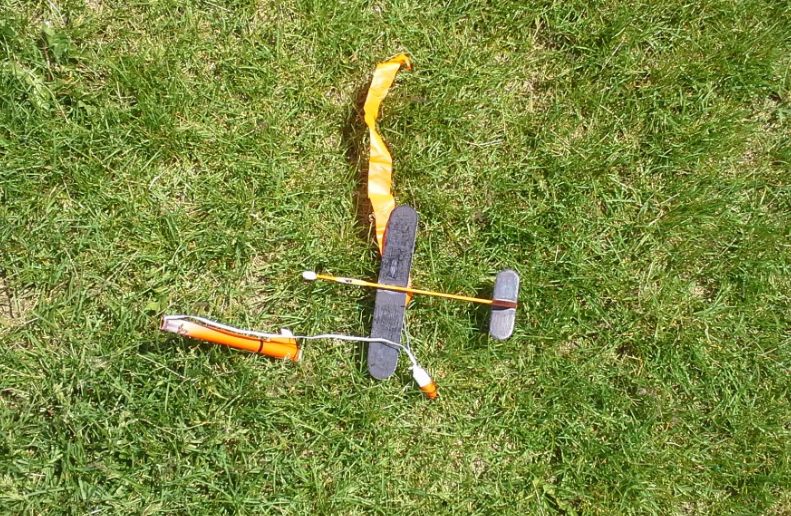
The other day, I was at the workbench sanding the Lunar Patrol Glider wings after another coat of filler.  Since this is a somewhat tedious job, my mind began to wander a bit to an odd subject.

Here’s the question I posed to myself:

“If the past tense of ‘hide’ is ‘hid’,
and the past tense of ‘slide’ is ‘slid’,
why then is the past tense of ‘glide’ ‘glided’ ?

It should be ‘glid’.

Just thinkin’…


Saturday, June 3, 2017

Launch Date: 31 May, 2017


The week following Memorial Day has been marked by increasingly mild weather conditions along the Colorado front range.  Close watch of local wind and weather forecasts revealed that today would be an ideal day to get in a little rocket flying., so I took a break from the endless yard work, packed up some rockets and gear, and headed out to Dove Valley Park.

Arriving around 10:45 a.m., the first bird to be prepped and launched was the old Hornet.  The model turned in yet another great flight on an A3-4T engine.

Next up was the much-anticipated maiden flight of the new Mini-Maggot boost glider.  After a series of hand launches, I had the glider trimmed out perfectly.  On one of these trim tosses, the glider ascended about 25 feet altitude, transitioned into glide, turned, and headed straight for me.  Before I could react, it bopped me right in the forehead!  Very helpful.

I was a bit concerned about attempting to launch this bird on a 1/4A engine with a 3 second delay, but I opted to proceed anyway.  My trepidation was confirmed at launch when the bird ascended straight up to a little over 100 feet, turned over, and headed straight down.  It pranged just when the ejection charge went off.


Much to my surprise, the glider survived the impact intact.  The power pod suffered only minor bending at the fore end of the body tube.  An easy fix that will have the Mini Maggot ready to fly another day. 

I think the glider can handle a 1/2A engine which can be had with a 2 second delay.  One bright spot of this flight was the great performance of the newly constructed glider rod and gantry system.

Since I had some spare ¼ A engines in the range box, out came the little Mosquito for a quick flight or two.


The first launch boosted the model straight and high, and, as expected with Mosquito flights, it disappeared after ejection.  Surprisingly, I spotted the model on the turf right away about 40’ distance from the launch pad.  No extended searching this time.

I quickly had the model ready to go for a second flight.  Nice thing about Mosquitos is the quick prep time.

Again, #105 boosted nicely.  By this time a bright, high altitude cloud had appeared overhead, so I didn’t even see the delay and ejection smoke.  I had to rely solely on the direction of the ejection sound to get an idea of where to start looking for the model.


This time, finding the rocket was not so easy. After a full 20 minutes of methodically searching the vicinity around the launch area, I had no Mosquito.  I did manage to find a lot of other orange things:

An orange drinking straw,

An orange candy wrapper,

An orange foam ear plug,

Even a piece of actual orange peel!

But no (BRIGHT) orange rocket.

Vexed and perplexed, I almost gave up , but decided to make one more circuit of the field, this time expanding the search radius by another 100 feet.


That’s when I finally found the bird…a full soccer field length’s distance from the launch pad. It was remarkable that it had traveled that far on a ¼ A engine!

On the long trek back to the launch area, I found this….


Doubtless left on the field after a kid’s soccer match.

“WINNER’” says the plastic medallion.

Was this a congratulatory message to me for having found the Mosquito, or is it instead a cruel mockery of the 25 minutes spent searching? 

Nevertheless, I am happy to have the Mosquito back after its 6th flight.  The ‘WINNER’ award will be proudly draped around the model’s display stand back at the workshop!

The final flight of the day was turned in by the Estes Lynx on an A10-3T engine.  This model has always proven to be a great performer, and today’s launch was no exception. 

Ignition and boost were perfect, but at ejection I saw no deployed parachute.  The model fell fairly quickly, but in a horizontal position with the ‘chute and shock cord tangled around the wings and fins.  The Lynx survived this little mishap without a scratch.

With that done, it was time to pack up and leave DV park to the sole possession of a gentleman who was out scanning the fields with a metal detector….

Friday, May 12, 2017

MPC Lunar Patrol, Part 6

Today, I finally had some time to resume work on the Lunar Patrol. 
The balsa stock for the glider nose cones has been mounted on the lathe for a few weeks now, while I have been engaged in other stuff - like massive yard work / landscaping projects.  The rest of the Lunar Patrol build is on hold , waiting for completion of these nose cones.

The first step is to turn down the square corners of the pine block to which the balsa stock is mounted.  I will be working in close proximity to this block, and I have no desire to have my knuckles busted by rapidly traveling square corners.


Next step is to bring the stock down to a cylinder.  This is done with a normal woodturning gouge, in a series of very light passes.  Balsa is quite splintery, and it's easy to take out chips and chunks if the work is done too aggressively.

Once the stock is down to around 1/8" of its target diameter, I switch to a medium grit sanding block.
Again, this needs to be done with a light touch.  Balsa sands down very quickly.  I stop the machine often to check my progress with a caliper set to the O.D. of a BT-20 body tube.

Once the stock is the right diameter, I use a pencil to mark out the fore and aft locations of the nose cone shoulder.  Since these nose cones will eventually be glued into the LP glider tubes, I'm only going with a 5/16" shoulder length.


The shoulder diameter is then turned using a straight file, and the nose cone profile is shaped using sanding blocks.  Again, the machine must be stopped often to check the profile with a template.


Finally finished.   The completed nose cone gets separated using a razor saw while the machine is spinning.


A few minutes later:  two completed Lunar Patrol nose cones!

Stay tuned for part 7 !!!!!

The FireFly Re-Visited


Last night, I had a little spare time on my hands, so I sat down at the rocket bench to repair the Firefly glider, which had suffered a broken attachment pin on its May 5th maiden flight.


As I was gluing the piece back on, I took a closer look.
This little piece of balsa is certainly required to do a lot.
In fact, it’s the prime focal point that takes the brunt of all the glider’s flight stresses.

First, it has to bear the G-forces acting on the glider at liftoff.

Next, it handles the weight of all the drag forces acting on the glider during boost and coasting phases of flight.

Then, it has to withstand any shock forces associated with engine ejection and glider separation.

Finally, it is always the first point of contact on the ground after gliding flight, i.e., the model’s ‘landing gear’.

That’s an awful lot to ask of a little sliver of balsa wood.

I realized that, if I didn’t want to be repairing this attachment pin after each and every flight, some engineering needed to be done to remedy this weak point.


Drawing on pop-pod boost/glider technology, I decided that the best course would be to apply some reinforcing sides on the pylon/pin assembly.

For this, I cut out a couple pieces of 1/32” thick plywood.

After sanding down the dowel pin to match the thickness of the glider’s nose, I wrapped a piece of sandpaper around a ¼ “ dowel and carved out a little hollow in the nose to make a cavity for holding a glob of trim clay.  This will cut down on the amount of clay that normally has to be molded around the outside of the nose for proper flight trimming.


The plywood sides are then glued on, shape sanded, and finished to match the rest of the model.


With this new design modification, it is hoped that the firefly will log many more flights without losing its nose every time!


Wednesday, May 10, 2017

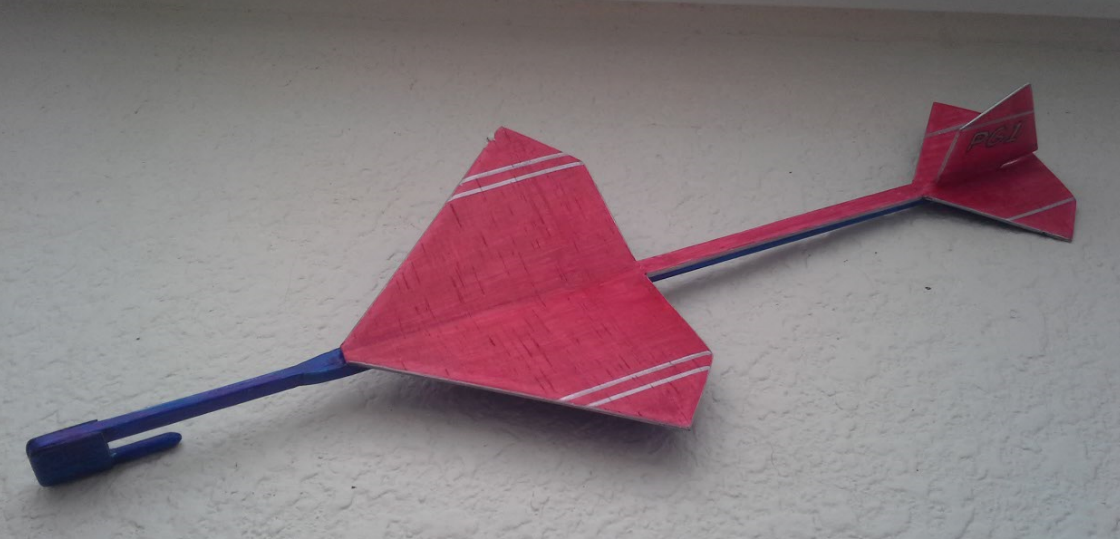
BAR Rocket Fleet # PG-1 Firefly-B


Parasite Glider
Rebuild of Estes Kit # 1280


Length:  12.0”  305mm
Wing Span:  4.5”  114mm
Weight:  .16 oz  4.6g

Color Scheme:  Red,
Dark Blue, Silver Trim

Date Completed: 
12 April, 2017

 “Hey…
...This One’s BUTT Don’t Light Up !!!”


The Firefly-B is a re-build of the original Estes Industries kit first introduced in 1976.  It’s not a certainty, but the glider design appears to have been adapted from an earlier ‘Cold Power’ rocket kit produced by Vashon Industries, the X-13 Rocket Plane. Vashon products were bought out by Estes and first appeared in their 1972 catalog.

It is also Estes’ first model kit designed without its own rocket power source, as it is intended to be flown attached to a different carrier rocket.


The Firefly is a very quick and easy build, featuring a balsa T-boom, delta wings and tail, and a forward dowel attachment pin.

The small aspect ratio of the wings takes the Firefly’s performance out of any competition-grade flight characteristics, but it does make for a fun-to-fly sport bird.


The model was built per kit instructions and was finished with a single coat of Dupli-color white primer, well-sanded, and color coats rendered by Sharpie markers to keep overall weight down.


Trimming the Firefly for gliding flight is a rather tricky process. It is sensitive to very small differences in angle of attack when hand launching.  It also takes a fair amount of trim clay on the nose to get it to settle into a smooth glide pattern without stalling.


My original ‘old fleet’ Firefly (# 55) was constructed in 1976.  It turned in six flights – two on a custom designed carrier rocket, and the remaining four strapped to the side of a Big Bertha.


Right:   Just me n' my Firefly. 
This was a 1978 launch with the glider strapped to the side of a shortened
Big Bertha


This original model was sold with the rest of the fleet in 1985.

Tuesday, May 9, 2017

First BAR Birthday

I hadn't noticed, but the 1st anniversary of my return to model rocketry was last week on May 2nd.
How time flies.

May 2, 2016 was the day that I walked into a HobbyTownUSA store and slapped down some bucks for an Estes Lynx kit, the very model that graces the header of this blog.

Over the past year I have conducted 12 launch sessions, completed 32 flight missions, built 7 new models, and refurbished 2 old fleet models,

Other completed projects include building of a new launch controller, 2 launch pads, and a boost glider umbilical tower.

In addition to this, I have built up a substantial collection of rocket plans and technical information, totally revamped my old fleet flight logs/documentation from the 1973-84 era,  constructed a nearly complete rocketry construction tool kit.

Oh, and then there was the equipping of the ol' range box....

Phew, that's a lot of stuff!

It has been a totally fun, year and I look forward to what comes next.

Thanks to all of you who have followed this blog!

Cheers!

Monday, May 8, 2017

Launch Date: 5 May, 2017

After more than a month of unsettled weather patterns, snow, and wind, May 5th promised great conditions for flying model rockets. 
Arriving at Dove Valley around 11:00 a.m , I found the conditions to be near perfect - wind at 0 to 5 mph, temperature close to 70 degrees, and a clear blue Colorado sky.  The field was in great condition as well, albeit a little damp from recent rains and/or park watering.
Mission #1
As you blog followers well know, the very first model flown at all of my launch sessions is the old Estes Mini-Brute Hornet.  It's my marker bird for assessing wind drift conditions, plus I'm shooting for that magical 100-flight mark.  This will be launch #32.  A long ways yet to go!
The Hornet boosted nice and straight on an A3-4T engine,  deployed its 8" parachute and drifted down, landing 40 feet from the launch pad.  Excellent flight.  So far, so good!


Mission #2
The next bird to be prepped was the 'old fleet' Delta II and recently completed payload section.  The last time the Delta II booster was flown was 25 April, 1981!


Launched on a B4-4 engine, the model did one of those cool slow ,straight liftoffs.  Reaching altitude, it deployed its 12" parachute and descended nicely, landing 50 feet from the launch area.  A great performance from a vintage bird.


Mission #3

I quickly prepped the Delta II for a second flight, again on a B4-4 engine.  For this launch, I taped on a launch lug at the fore end of the booster to accommodate a recently constructed Estes Firefly parasite glider.

After a few dozen hand tosses, I had the glider trimmed reasonably well.  These models are a bit tricky to balance and trim, having  a small delta wing with a small aspect ratio.
The tandem boosted nicely, with the ejection charge occurring right at apogee. 


To my chagrin, the model began descending with no parachute deployment.  The payload section had just barely popped off of the carrier tube.  I also noted that the Firefly was still attached. 
I watched the whole mess free-fall, fearing the worst.  At least the entire rocket had assumed a horizontal position during its descent, so the 'crash' wasn't as severe as it had the potential to be.
Upon  recovery, I was delighted to discover that the Delta-II had sustained no damage whatsoever.  The Firefly's attachment pin had broken off on the impact, but that is an easy repair.  Phew! Dodged a bullet, here.
A post-flight inspection revealed the cause of the malfunction.  Apparently, the recovery wadding from the first flight had not ejected from the tube.  I hadn't noticed this while prepping for the second flight, so I stuffed another load of wadding in.  This was simply too much stuff for the B4 engine to eject.  It only had enough "Ooomph'" to dislodge the payload section.  This also explains why the Firefly did not separate.  There was not enough ejection kick-back going on.


Too much wadding...and, oh, the burnt smell!
Mission #4  CATASTROPHIC FAILURE #1
It was bound to happen....
The first spectacular model rocket crash of my BAR career.
The final launch of the day was a second test of the Open Air Gap Staging booster.
The hapless victim of this event was the Centuri Star Trooper clone.
The AGS booster was loaded with an A10-0T engine, and was attached to the launch rod via a clothespin.  It was not intended to fly - only to remain on the pad and ignite the upper stage engine.
Sitting atop the booster was the Star Trooper, equipped with an A10-3T.  It would be nice if Estes made an A10 with a 5 or 6 second delay for upper stage work, but I will have to roll with what's available.


At ignition, the model completely dislodged the clothespin, and the whole thing took off on ballistic flight.  Since the booster section does not have any fins, you can imagine what happened next.
The model boosted to about 30 feet in extremely unstable flight.

The beginning of a bad flight.  That's the clothespin
next to the exhaust plume that should have been
holding the booster on the pad...
Lo and behold, the staging sequence worked!  By this time, however the Star Trooper was oriented horizontally.
The resulting power prang was brutal!
With the model sticking in the turf about fifty feet from the launch pad, the delay charge burned, and the ejection charge shot the engine out the model's tail.  I found the casing about 40 feet away from the crash site.
Damage to the Trooper consisted of two completely missing fins, a missing forward launch lug, and a lot of dings and dirt smudges on the airframe.
The bird is actually salvageable and will be re-built to fly another day!
After a five minute search, the AGS booster was found.  No damage at all.


Despite this disastrous outcome, the original mission objective was successfully accomplished:  Iginition of the upper stage from an open air gap booster!
The next step in the project is to add fins and finish to the booster section, repair the Trooper, and fly the tandem again in normal staging configuration.
Stay tuned.

With only a 50% success rate for the flight session, I packed up and bade farewell to Dove Valley Park....