I hadn't noticed, but the 1st anniversary of my return to model rocketry was last week on May 2nd.
How time flies.
May 2, 2016 was the day that I walked into a HobbyTownUSA store and slapped down some bucks for an Estes Lynx kit, the very model that graces the header of this blog.
Over the past year I have conducted 12 launch sessions, completed 32 flight missions, built 7 new models, and refurbished 2 old fleet models,
Other completed projects include building of a new launch controller, 2 launch pads, and a boost glider umbilical tower.
In addition to this, I have built up a substantial collection of rocket plans and technical information, totally revamped my old fleet flight logs/documentation from the 1973-84 era, constructed a nearly complete rocketry construction tool kit.
Oh, and then there was the equipping of the ol' range box....
Phew, that's a lot of stuff!
It has been a totally fun, year and I look forward to what comes next.
Thanks to all of you who have followed this blog!
Cheers!
Tuesday, May 9, 2017

Monday, May 8, 2017
Launch Date: 5 May, 2017
After more than a month of unsettled weather patterns, snow, and wind, May 5th promised great conditions for flying model rockets.
Arriving at Dove Valley around 11:00 a.m , I found the conditions to be near perfect - wind at 0 to 5 mph, temperature close to 70 degrees, and a clear blue Colorado sky. The field was in great condition as well, albeit a little damp from recent rains and/or park watering.
Mission #1
As you blog followers well know, the very first model flown at all of my launch sessions is the old Estes Mini-Brute Hornet. It's my marker bird for assessing wind drift conditions, plus I'm shooting for that magical 100-flight mark. This will be launch #32. A long ways yet to go!
The Hornet boosted nice and straight on an A3-4T engine, deployed its 8" parachute and drifted down, landing 40 feet from the launch pad. Excellent flight. So far, so good!

Mission #2
The next bird to be prepped was the 'old fleet' Delta II and recently completed payload section. The last time the Delta II booster was flown was 25 April, 1981!

Launched on a B4-4 engine, the model did one of those cool slow ,straight liftoffs. Reaching altitude, it deployed its 12" parachute and descended nicely, landing 50 feet from the launch area. A great performance from a vintage bird.
Mission #3
I quickly prepped the Delta II for a second flight, again on a B4-4 engine. For this launch, I taped on a launch lug at the fore end of the booster to accommodate a recently constructed Estes Firefly parasite glider.

After a few dozen hand tosses, I had the glider trimmed reasonably well. These models are a bit tricky to balance and trim, having a small delta wing with a small aspect ratio.
The tandem boosted nicely, with the ejection charge occurring right at apogee.

To my chagrin, the model began descending with no parachute deployment. The payload section had just barely popped off of the carrier tube. I also noted that the Firefly was still attached.
I watched the whole mess free-fall, fearing the worst. At least the entire rocket had assumed a horizontal position during its descent, so the 'crash' wasn't as severe as it had the potential to be.
Upon recovery, I was delighted to discover that the Delta-II had sustained no damage whatsoever. The Firefly's attachment pin had broken off on the impact, but that is an easy repair. Phew! Dodged a bullet, here.
A post-flight inspection revealed the cause of the malfunction. Apparently, the recovery wadding from the first flight had not ejected from the tube. I hadn't noticed this while prepping for the second flight, so I stuffed another load of wadding in. This was simply too much stuff for the B4 engine to eject. It only had enough "Ooomph'" to dislodge the payload section. This also explains why the Firefly did not separate. There was not enough ejection kick-back going on.
Mission #4 CATASTROPHIC FAILURE #1
It was bound to happen....
The first spectacular model rocket crash of my BAR career.
The final launch of the day was a second test of the Open Air Gap Staging booster.
The hapless victim of this event was the Centuri Star Trooper clone.
The AGS booster was loaded with an A10-0T engine, and was attached to the launch rod via a clothespin. It was not intended to fly - only to remain on the pad and ignite the upper stage engine.
Sitting atop the booster was the Star Trooper, equipped with an A10-3T. It would be nice if Estes made an A10 with a 5 or 6 second delay for upper stage work, but I will have to roll with what's available.
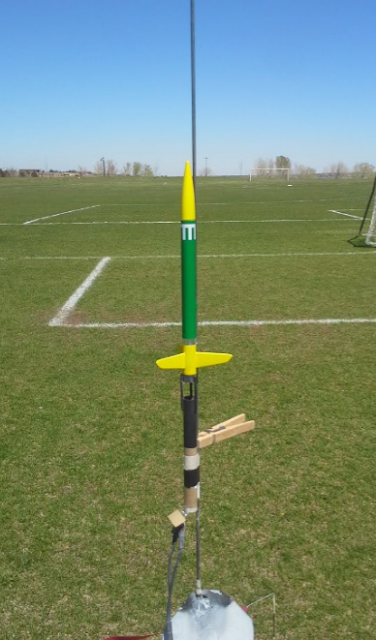
At ignition, the model completely dislodged the clothespin, and the whole thing took off on ballistic flight. Since the booster section does not have any fins, you can imagine what happened next.
The model boosted to about 30 feet in extremely unstable flight.
Lo and behold, the staging sequence worked! By this time, however the Star Trooper was oriented horizontally.
The resulting power prang was brutal!
With the model sticking in the turf about fifty feet from the launch pad, the delay charge burned, and the ejection charge shot the engine out the model's tail. I found the casing about 40 feet away from the crash site.
Damage to the Trooper consisted of two completely missing fins, a missing forward launch lug, and a lot of dings and dirt smudges on the airframe.
The bird is actually salvageable and will be re-built to fly another day!
After a five minute search, the AGS booster was found. No damage at all.

Despite this disastrous outcome, the original mission objective was successfully accomplished: Iginition of the upper stage from an open air gap booster!
The next step in the project is to add fins and finish to the booster section, repair the Trooper, and fly the tandem again in normal staging configuration.
Stay tuned.
With only a 50% success rate for the flight session, I packed up and bade farewell to Dove Valley Park....
Arriving at Dove Valley around 11:00 a.m , I found the conditions to be near perfect - wind at 0 to 5 mph, temperature close to 70 degrees, and a clear blue Colorado sky. The field was in great condition as well, albeit a little damp from recent rains and/or park watering.
Mission #1
As you blog followers well know, the very first model flown at all of my launch sessions is the old Estes Mini-Brute Hornet. It's my marker bird for assessing wind drift conditions, plus I'm shooting for that magical 100-flight mark. This will be launch #32. A long ways yet to go!
The Hornet boosted nice and straight on an A3-4T engine, deployed its 8" parachute and drifted down, landing 40 feet from the launch pad. Excellent flight. So far, so good!

Mission #2
The next bird to be prepped was the 'old fleet' Delta II and recently completed payload section. The last time the Delta II booster was flown was 25 April, 1981!

Launched
 on a B4-4 engine, the model did one of those cool slow ,straight liftoffs. Reaching altitude, it deployed its 12" parachute and descended nicely, landing 50 feet from the launch area. A great performance from a vintage bird.
Mission #3
I quickly prepped the Delta II for a second flight, again on a B4-4 engine. For this launch, I taped on a launch lug at the fore end of the booster to accommodate a recently constructed Estes Firefly parasite glider.

After a few dozen hand tosses, I had the glider trimmed reasonably well. These models are a bit tricky to balance and trim, having a small delta wing with a small aspect ratio.
The tandem boosted nicely, with the ejection charge occurring right at apogee.

To my chagrin, the model began descending with no parachute deployment. The payload section had just barely popped off of the carrier tube. I also noted that the Firefly was still attached.
I watched the whole mess free-fall, fearing the worst. At least the entire rocket had assumed a horizontal position during its descent, so the 'crash' wasn't as severe as it had the potential to be.
Upon recovery, I was delighted to discover that the Delta-II had sustained no damage whatsoever. The Firefly's attachment pin had broken off on the impact, but that is an easy repair. Phew! Dodged a bullet, here.
A post-flight inspection revealed the cause of the malfunction. Apparently, the recovery wadding from the first flight had not ejected from the tube. I hadn't noticed this while prepping for the second flight, so I stuffed another load of wadding in. This was simply too much stuff for the B4 engine to eject. It only had enough "Ooomph'" to dislodge the payload section. This also explains why the Firefly did not separate. There was not enough ejection kick-back going on.
 |
| Too much wadding...and, oh, the burnt smell! |
It was bound to happen....
The first spectacular model rocket crash of my BAR career.
The final launch of the day was a second test of the Open Air Gap Staging booster.
The hapless victim of this event was the Centuri Star Trooper clone.
The AGS booster was loaded with an A10-0T engine, and was attached to the launch rod via a clothespin. It was not intended to fly - only to remain on the pad and ignite the upper stage engine.
Sitting atop the booster was the Star Trooper, equipped with an A10-3T. It would be nice if Estes made an A10 with a 5 or 6 second delay for upper stage work, but I will have to roll with what's available.

At ignition, the model completely dislodged the clothespin, and the whole thing took off on ballistic flight. Since the booster section does not have any fins, you can imagine what happened next.
The model boosted to about 30 feet in extremely unstable flight.
 |
The beginning of a bad flight. That's the clothespin
next to the exhaust plume that should have been
holding the booster on the pad... |
The resulting power prang was brutal!
With the model sticking in the turf about fifty feet from the launch pad, the delay charge burned, and the ejection charge shot the engine out the model's tail. I found the casing about 40 feet away from the crash site.
Damage to the Trooper consisted of two completely missing fins, a missing forward launch lug, and a lot of dings and dirt smudges on the airframe.
The bird is actually salvageable and will be re-built to fly another day!
After a five minute search, the AGS booster was found. No damage at all.

Despite this disastrous outcome, the original mission objective was successfully accomplished: Iginition of the upper stage from an open air gap booster!
The next step in the project is to add fins and finish to the booster section, repair the Trooper, and fly the tandem again in normal staging configuration.
Stay tuned.
With only a 50% success rate for the flight session, I packed up and bade farewell to Dove Valley Park....
Saturday, April 29, 2017
A Cheap and Simple Boost/Glider Launch System
My return to the hobby of space modeling as a 'Born Again Rocketeer' has abruptly whisked me off into the realm of front engine boost and rocket gliders. I knew it would only be a matter of time before I was once again diving into what was undoubtedly my most favorite facet of model rocketry in the earlier days.
That being the case, it is now imperative that I build an appropriate ground support system to accommodate these interesting models. And, having allotted myself a limited amount of monetary resources for model rocketry, this system must be built on the cheap!
There are two major criteria for building a good launch system for front engine gliders:
Launch rod length, and preventing clip lead hang-ups.
The Launch Rod
Many rocketeers (myself included) have made the mistake of using a standard 36-inch launch rod to provide initial guidance for their front engine B/Gs. The problem here is that the length of the glider requires that the engine pod be placed higher on the rod. This results in only 18-24 inches of effective rod length remaining to guide the model. Usually, a glider model hasn’t reached sufficient airspeed over this short distance to continue in a vertical ballistic trajectory. In most cases, the model will leave the rod and ‘tip off’ in any direction, resulting in a near horizontal or spiraling flight path, sacrificing altitude. In the worst case, the model is quite prone to attempting to enter a region of extremely high drag (the ground) under power.
“No good!” says BlastFromThePast.
There are two effective methods for achieving proper launch rod length for B/Gs and R/Gs. The first is to simply build an extension of the launcher, such as a wood dowel or a metal bar where the launch rod can be inserted into the end.
The other method is to simply get a longer launch rod.
That is my choice for the new launcher, so a trip to the BORG (that’s Big Orange Retail Giant a.k.a. Home Depot) to pick up a 1/8” x 48” rod, was in order. I was quite surprised to find that it took a little bit of searching through the available stock to find a perfectly straight rod.
Chinesium. Harumph!
Now, with a standoff, I can place most any B/G model on the rod and have enough length to properly guide the model.
But, what about the second point?
The Clip Leads
Merely hanging some unsupported clip leads from the engine pod introduces the risk of having them fall and hang up on the glider at ignition.
The solution – build a gantry to hold the leads and allow them to swing AWAY from the glider after having performed their assigned task.
My version of this device is engineered quite simply, using a couple scraps of wood and a small assortment of hardware.
First, a base is cut from a small 1x3 block of hard maple. A 1/8” diameter hole is drilled in the center to allow the base to fit snugly over the launch rod.

Normally, I would perform this function the ‘Neanderthal’ way, using an old timey ‘eggbeater’ hand drill. But, since I need this hole to be exactly perpendicular to the rod, I had to fire up the drill press for better accuracy.
Next, a 12” stick of ½” square pine is scrounged out of the wood scrap box. This will make a dandy gantry.
To mount the gantry to the base, I will be using a common small angle bracket. Since I want the gantry to lean slightly away from the launch rod, the bracket gets squished between some vise jaws to bend it at to approximately 110 degrees.

To hold the clip leads, a hook is made from a short length of clothes hanger wire. This will be inserted into a hole at the top of the gantry.
I told you this project would be cheap and simple…

Before final assembly., the wood pieces are sanded smooth and painted to look more ‘purty’.
All the parts are now attached using small flat head screws.

The clip hook is inserted into a hole drilled at the top end of the gantry...

Voila! A cheap, yet efficient launcher accessory.


Nothing fancy. Nothing schmancy. Cost me all of a few cents and an hour to build.
Now it’s off to fly me some Boost/Gilders!
Thursday, April 27, 2017
Back In The Day, Part 4 - A Heart-Stopping Astrocam 110 Flight!
Now that I have recently completed restoration of the vintage Delta II carrier vehicle to operational condition, I must regale all of you blog-readers with the exciting tale of a flight turned in by this model back on April 25th, 1981.
The location for this launch was the Rustic Hills North shopping center in Colorado Springs, located at the north-east corner of the intersection of Academy and Palmer Park Boulevards.
The event was a Spring demonstration launch put on by the Skywatchers / ROMAR rocket club.
This annual affair was sponsored by the Ru-Jan Party and Hobby Shop, which was located in the strip mall on the north side of the parking lot.
I had brought along my Delta II / Astrocam tandem to fly at this event in the hopes of getting a good aerial photo of the demo site.

I should have known better, but I decided to fly the bird on a B14-5 engine (some of you old BARs might remember these).
After a little bit of Public Address fanfare, asking the spectators to "smile for the camera!", the model was launched.
The Delta II boosted straight up to a respectable altitude, arched over, and began a screaming ballistic descent toward the parking lot!
It was then that I realized that a 5 second delay is pretty darn long.
I watched as the model streaked closer and closer to what I was sure would be its spectacular demise...
Then...POP...off went the ejection charge...maybe a mere fifty feet above the asphalt!
The parachute deployed immediately, and lowered the model for a gentle landing. It's a good thing the 'chute was equipped with over-the-canopy shroud lines or it could have easily been shredded by the heavy model traveling at a high velocity.
Here is the photograph snapped by the Astrocam...

This is a good shot of what might have become the camera's final 'parking spot' !!
To this day, I still have not been able to identify the mysterious object resting in one of the adjacent spots.
Cheers!
The location for this launch was the Rustic Hills North shopping center in Colorado Springs, located at the north-east corner of the intersection of Academy and Palmer Park Boulevards.
The event was a Spring demonstration launch put on by the Skywatchers / ROMAR rocket club.
This annual affair was sponsored by the Ru-Jan Party and Hobby Shop, which was located in the strip mall on the north side of the parking lot.
I had brought along my Delta II / Astrocam tandem to fly at this event in the hopes of getting a good aerial photo of the demo site.

I should have known better, but I decided to fly the bird on a B14-5 engine (some of you old BARs might remember these).
After a little bit of Public Address fanfare, asking the spectators to "smile for the camera!", the model was launched.
The Delta II boosted straight up to a respectable altitude, arched over, and began a screaming ballistic descent toward the parking lot!
It was then that I realized that a 5 second delay is pretty darn long.
I watched as the model streaked closer and closer to what I was sure would be its spectacular demise...
Then...POP...off went the ejection charge...maybe a mere fifty feet above the asphalt!
The parachute deployed immediately, and lowered the model for a gentle landing. It's a good thing the 'chute was equipped with over-the-canopy shroud lines or it could have easily been shredded by the heavy model traveling at a high velocity.
Here is the photograph snapped by the Astrocam...

This is a good shot of what might have become the camera's final 'parking spot' !!
To this day, I still have not been able to identify the mysterious object resting in one of the adjacent spots.
Cheers!
Tuesday, April 25, 2017
The Old Delta II Rides Again!
This model is one of the
two ‘old fleet’ rockets that were retained when the collection was sold in
1985.
Like the old fleet Hornet,
the Delta II / Astrocam110 spent 30+ years stored in a RubberMaid tote along
with other model rocket items.
 In early 2016, when my BAR
activities began, the Delta/Astrocam110 tandem was pulled from storage and put
on a display stand in the workshop.
In early 2016, when my BAR
activities began, the Delta/Astrocam110 tandem was pulled from storage and put
on a display stand in the workshop.
It wasn’t long before I
made the determination that the model would be restored to flying condition and
launched again in the BAR era. The
Astrocam110 payload will not be flown, because of the inherent risk of losing
or damaging what I consider to be a collector’s item.
I had entertained the thought of trying to
get ahold of some 110 film cartridges and fly the Astrocam110 as intended. After researching, I found that such film is
prohibitively expensive (at least on my hobby budget). Also, finding a place that will process the
film might be difficult and costly. Better to leave well-enough alone.
Instead, a new payload
section has been built to fly atop the Delta II booster. This consists of a length of BT-50, a PNC-50
nose cone, and a lathe-turned balsa transition section.
 |
| A new balsa transition section fresh off the lathe. |
Curiously, when the Delta
II/Astrocam was first pulled from the storage box, I popped the camera payload
off and was met with the strong odor of burnt black powder, as if the model had
been launched only yesterday!
“No way”, I exclaimed,
“This thing’s been in storage since 1985!”
I soon found out why…
 |
The original Delta II / Astrocam 110 model.
|
Apparently, back in the
day, I had prepped the model for another flight, which never took place.
Inside the body tube were
still packed the recovery wadding, folded parachute, and shock cord.
The wadding had essentially sealed the tube,
and the BP smell from the model’s last flight (April 25th, 1981,
according to the flight logs) was still present after all these years.
Go figure!
Now, fully equipped with a
new payload section and shock cord, the Delta II is quite ready to log many additional flight missions.
Possible future plans for
the model may call for constructing yet another payload section designed to
carry one of those small spy video cameras.
For now, however, I will
enjoy flying old number 79 as a sport bird.
Here are a couple more pix of the payload section under construction.....


Some Nifty Rocket Display Stands
In fulfilling my promise to Mrs. BlastFromThePast concerning
keeping my model rocketry activities nice and pretty, I have been setting about
fashioning some attractive display stands for the model collection.
Since I also enjoy the pleasures of hand tool woodworking,
the new stands are built completely with vintage tools.


 |
Mark the center with an awl for boring a hole for a support dowel…
|
 |
An "Old Timey" brace and auger bit to bore the hole.
In this case a number 6 auger is being used to make the hole for a 3/8” dowel.
Vintage augers bits are stamped with a number that represents how many 16ths of an inch of diameter they are.
|
 |
| One edge beveled at approx. 45 degrees using a smoothing plane… |
 |
| The Completed base. |
 |
| Cutting the dowel to length with a razor saw…. |


 |
| Application of little matte black acrylic paint… |
 |
| And finally, a few squares of felt glued to the bottom of the base… |
 |
| Another in a fine and dandy set of model rocket display stands! |
Saturday, April 22, 2017
Back In The Day, Part 3 - A Man of Many Boost Gliders
In looking through the scrap book of photos and flight log
records spanning my early years in the wonderful hobby of model rocketry, I
found that a good number of my model fleet consisted of boost gliders or models
with a gliding component. A full 25% of them, in fact!
The majority of these gliding birds were built for NAR
competition events. Many were of my own design. I experimented with nearly all aspects of
boost glider technology prevalent in the day – standard front engine pop pods,
variable geometry rocket/gliders, parasite gliders, ejectable flex wings, you
name it. There were even a couple of
commercial sport glider models thrown into the mix: an Orbital Transport, a Scissorwing Transport,
and an MPC Lunar Patrol. The only
variety of boost/glider I didn’t build was a rear engine Space-Plane-type
model. That design was pretty much passe by the time I started diving into serious
B/G competition.
This collection of gliders ran the gamut of various degrees
of success. Some crashed and burned on
their first flight, while others performed wonderfully. Some glided like streamlined bricks, while
others fluttered like feathers. A couple were lost to engine CATOs right on the
launch pad. There were a few ‘Red
Barons’. The best ones were lost when
they were ‘thermaled’ away into the wild blue beyonder, never to be seen again.
A few even won some meet ribbons and
garnered NAR contest points.For me, this whole collection of balsa, spruce, plywood, and sheet plastic represented one of the most gratifying facets of model rocketry. There is nothing quite like the sight of a well-built glider model climbing straight up, separating, and wheeling in lazy circles.
Today, as a Born Again Rocketeer, I have so far limited my
new model rocket fleet to small, 13mm-powered standard birds, but I have been
certainly eyeballing a lot of boost/glider models, designs both past and
present. Since my first BAR boost/glider
just recently came off the work bench, I
thought I would post a montage of some of my ‘old fleet’ B/Gs and R/Gs. Most likely, some of my future rocket
projects will be re-makes of some of these old glider faves from years ago
(1975-1984).
Oh, and I think it’s high time that I get around to building
that Space Plane, too…..




Subscribe to:
Comments (Atom)